
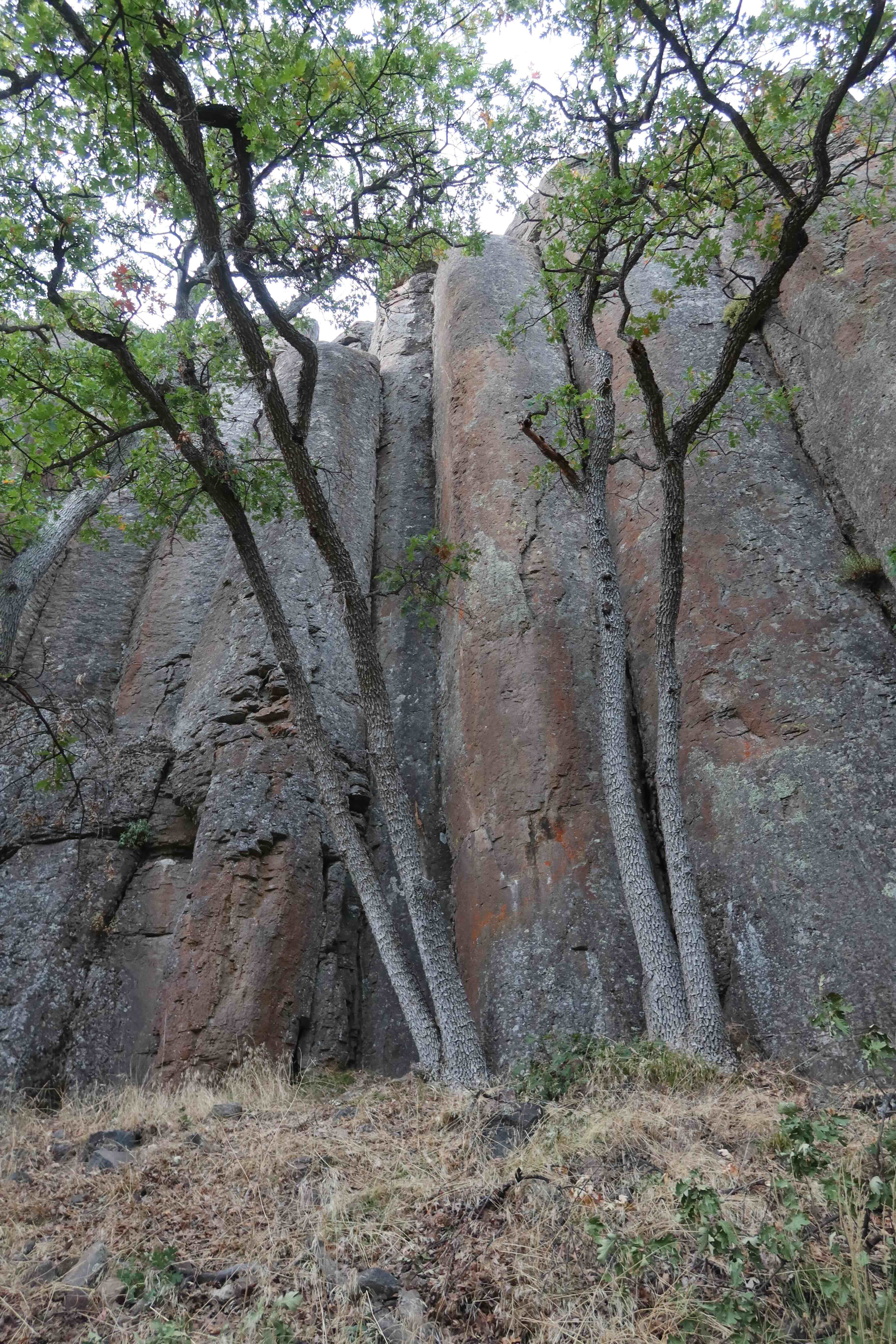
From what I can tell, the Windy Point Columns is a cragging area that saw some use in the past, (I think mostly in the 1980’s), but has been virtually abandoned in more recent decades, up until now. I’ve worked to revive seven possible single-pitch crack climbs, all of which I imagine have been climbed before, but none of which could I find any beta on what-so-ever. I’ve cleaned these routes, given them modern bolted top-anchors, and given them creative new names that I’ll use for the time being. (I do not know past route names or FA information for any of these lines. If you do, please reach out, and I’ll update my information appropriately.)
Background
I’ve long wished that I could find additional good teaching locations, for the benefit of The Mountaineers or anyone else. Ideally somewhere with many very-easy crack lines clustered together in an easily-usable single-pitch setting, and it would be amazing if they were easy enough to be someone’s first trad lead. This is not quite that, I still haven’t quite found any location that really feels ideal for that, but I did finally put some time into exploring, cleaning, and equipping one of the better potential candidates that had been on my mind: Tieton’s Windy Point Columns. Passing mentions of the “Windy Point Columns” in guidebooks had made me raise an eyebrow long ago, and it had been in the back of my mind for years as something to explore for this sake.
Once upon a time, “Mountaineers Dome” in Leavenworth had been the perfect spot for teaching trad to first-timers, but a painfully-limited quantity of usage permits for The Mountaineers organization had made it effectively an unusable location for officially teaching as a club outing for many years. Tieton’s Royal Columns, especially the easier routes at the far-left end, became the club’s best bet for an alternative location after Leavenworth closed up, but Royal Columns is also rather busy and crowded, and only has a very small number of truly-easy first-timer routes, so it still seemed like an alternative location was much-needed. The final small-nudge that got me to start taking action on the Windy Point Columns was this year’s closure of Vantage, due to the rockslide over the access road, which I’ve heard might not be fixed until late-2027, for some unfortunate county-budget reasons. That closure leaves a lot fewer dry-Eastern-Washington cragging destinations, and is likely going to really put some crowding-pressure on Royal Columns itself, so I wanted to do this to possibly create at least a small pressure-release-valve to that Royal Columns usage. Hopefully some teaching-group that was going to use Royal Columns perhaps chooses to use the Windy Point Columns instead. Windy Point Columns is quite small and limited compared to those more classic locations, but it still could be useful to a group that wants to climb a few Tieton-5.7 cracks.
In terms of prior-information, the old guidebook “Tieton River Rocks” from 2004 by Marlene Ford & Jim Yoder mentions the Windy Point Columns on page 80 & 81, but doesn’t give a lot of specifics, just saying vaguely that “…the routes we climbed are all moderate in rating (5.6 to 5.9)” and “there are two or three bolted pillars and the rest are crack climbs,” with essentially no more information than that, and encourages exploring and cleaning routes. The newer excellent guidebook, “CLIMB TIETON”, by Jacob Blesher, Andy Fritz, and Walter Jordan in 2024, gives a brief mention of the Windy Point Columns on page 90, and a bit more detail at the top of page 134, including even one actual named route description! (A route named “The Twinkie”, FA in 1989 by John Eminger and Scott Spees, 4 bolts on some column, but not really any clues as to which column.) Also on that page, the book says “If someone were to put work into cleaning and equipping the lines, it would probably be a fine beginner area…” Geez, that is so in-line with what I had already been thinking; I certainly do want there to be more beginner areas!! The “Climb Tieton” book also has an interesting section on the climbing-history of the area, around page 15, which probably holds some loose clues to who had originally climbed these Windy Point Columns routes, the routes I’m effectively rediscovering now, but really doesn’t say anything specific. Nor could I find enough to fill even one page of Google-search-results about the “Windy Point Columns” prior to me writing this post. Anyway, this paragraph is literally all the information that seemed to exist in books or on the internet about the Windy Point Columns up until now. The rest I figured out by going out there and exploring for myself.
Over the course of many, many weekend trips in the fall of 2026, I managed to clean and scrub seven different cracks, and install six shiny new bolted top-anchors (one is shared between two routes,) and got work done on these routes to the point that I feel good about encouraging regular craggers to get on those particular seven routes at this point (as opposed to having to be a highly-dirt-tolerant route-developer type of climber, which is more the mindset you’d need if you wanted to explore any of the other cracks in the area). This was mostly a solo effort on my part, though I did get some major assists from my friend Rory H, who joined me for a day of some really blue-color crack excavating, and I also want to shout-out Jessica, Denise, Claire, and Bennett who came out for my final “soft opening” day to test out leading many of the cracks and come up with a group consensus on initial difficulty-ratings, so that I could finally write up this page.
Routes
As of the end of 2026, these are the seven routes I’ve worked on cleaning in the area:
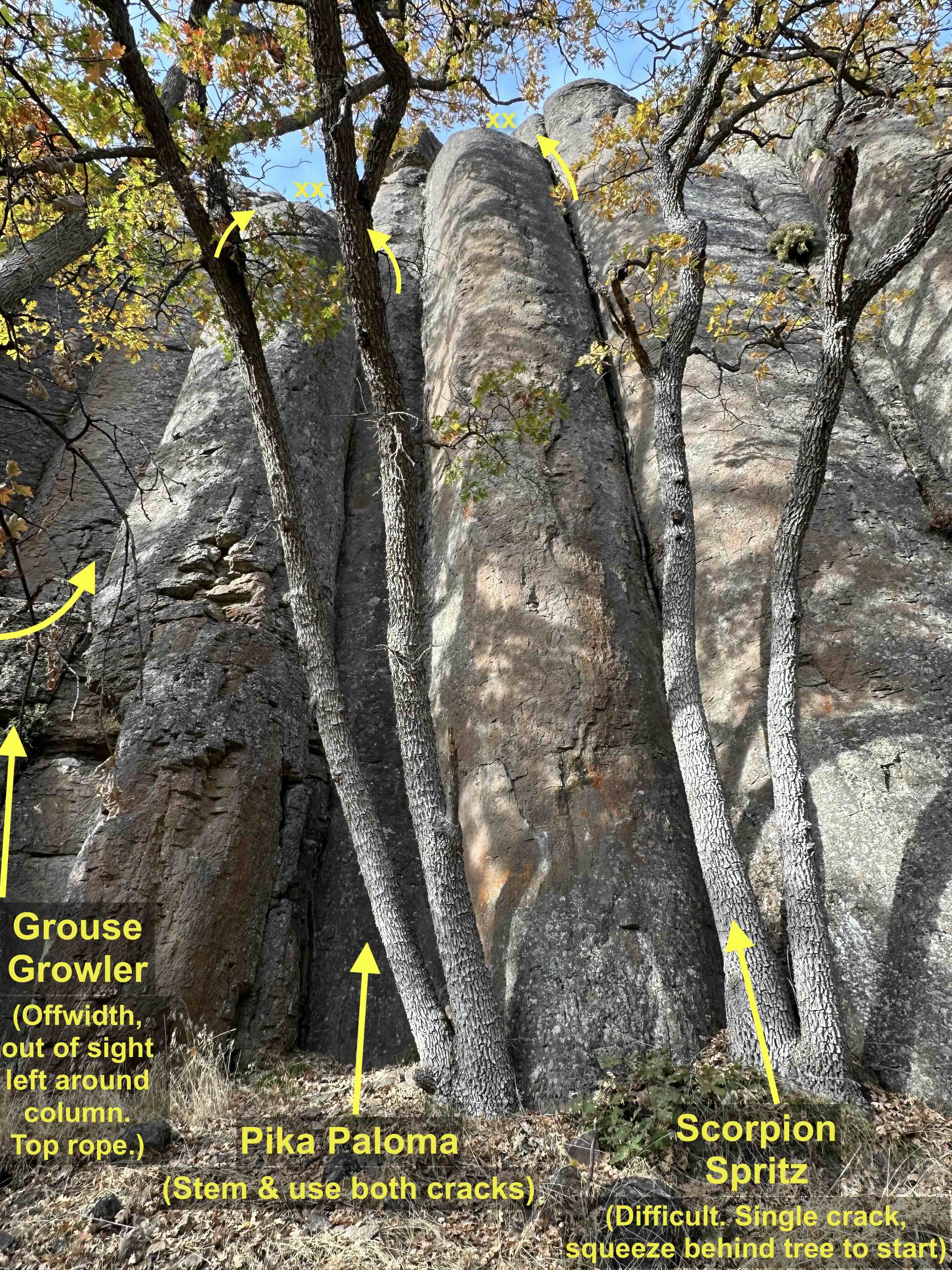
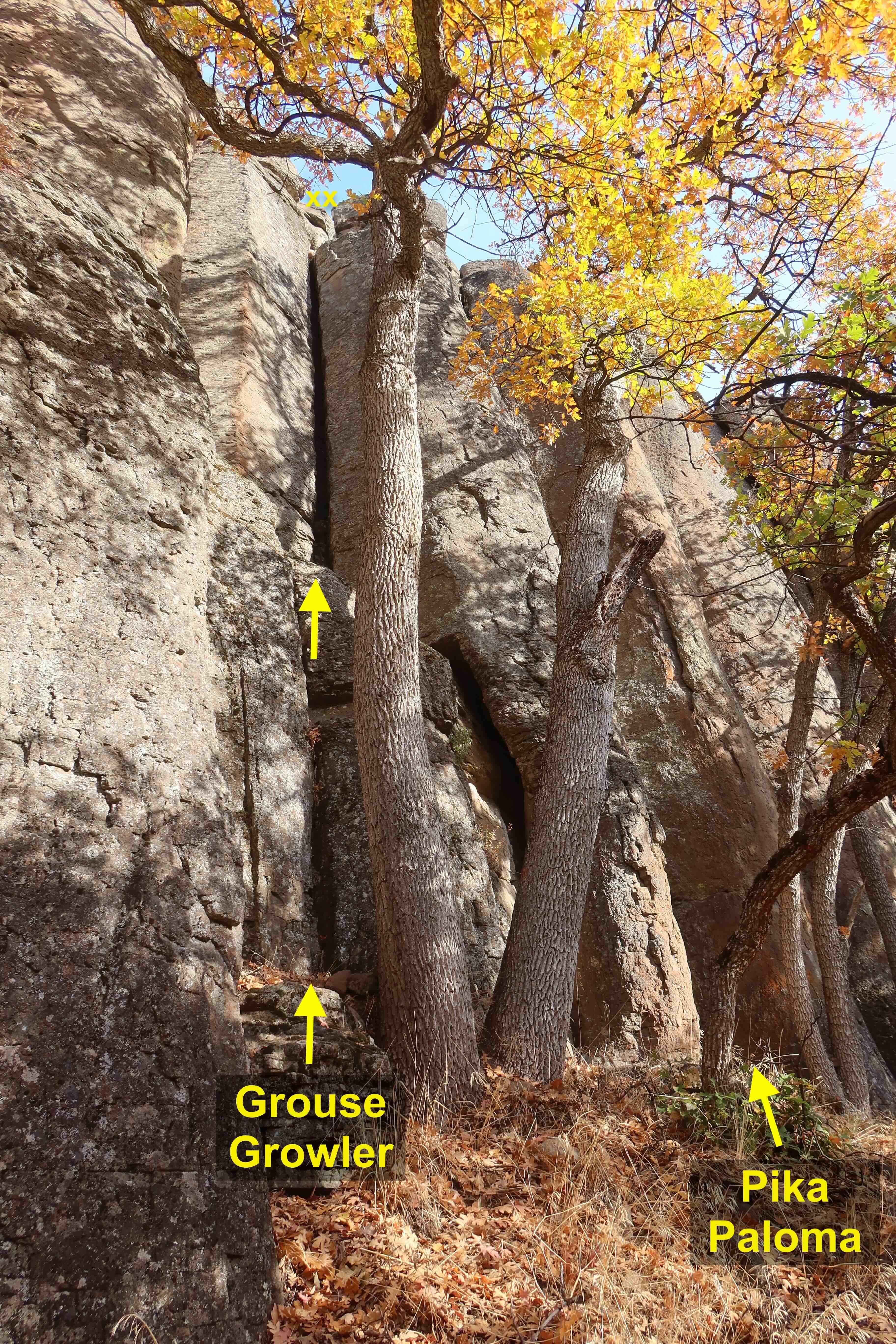
- “Grouse Growler”, 5.8, ~70 feet – an off-width that’s quite fun on top-rope (small edges for feet outside of the crack means that it’s actually pretty light on the amount of offwidth-technique is required. It shares an anchor with Pika Paloma, and personally, I would choose to just top-rope Grouse Growler. If you really wanted to lead it though, you’d probably want to bring two BD #6’s (the jolly green giants) and alternate bumping them. (I have not led this one…yet.)
- “Pika Paloma”, 5.7+, ~70 feet –
- “Scorpion Spritz”, 5.9, ~70 feet –
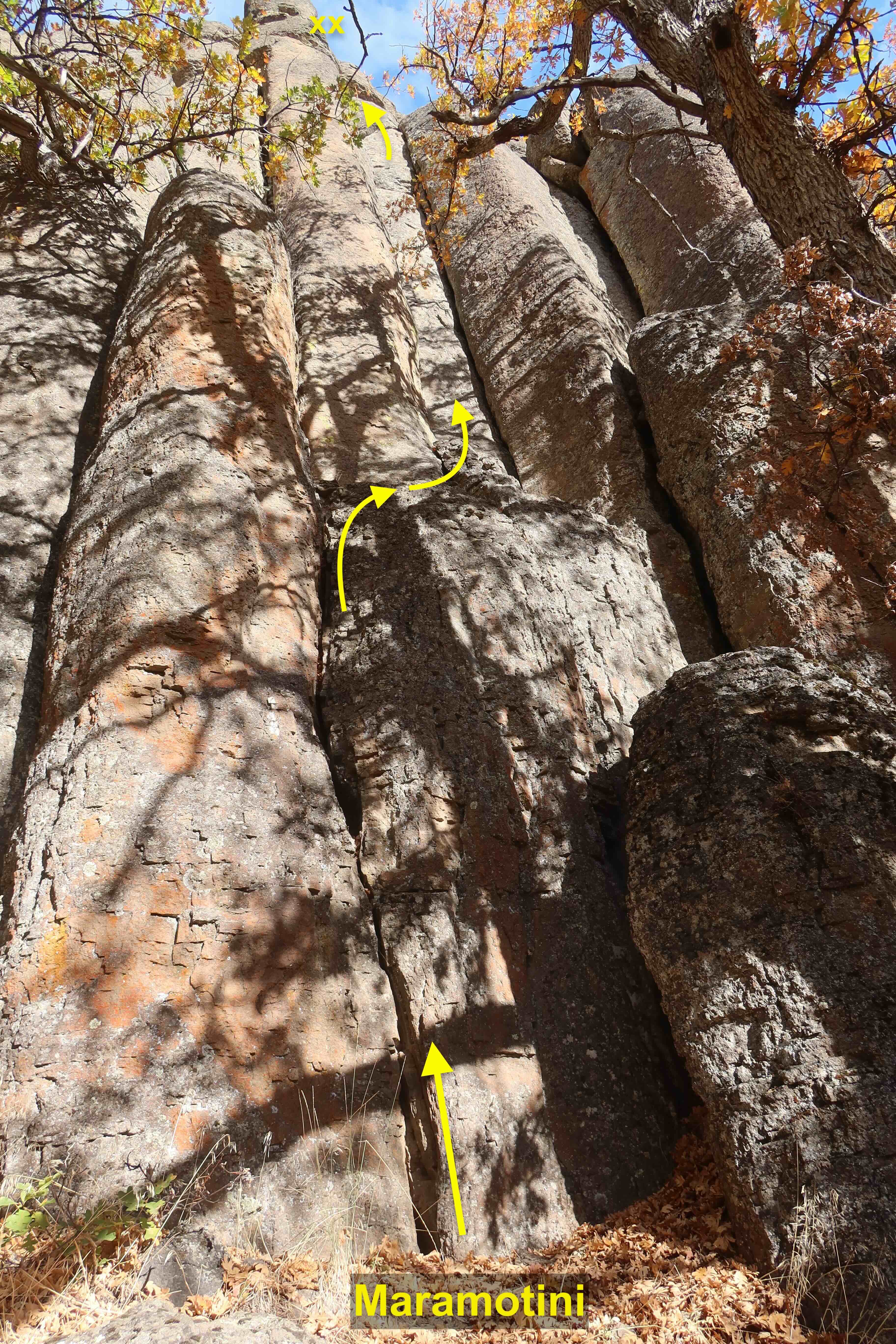
- “Marmotini”, 5.7, ~70 feet –
- “Magpie”, 5.7, ~45 feet –
- “Cyanocitta”, 5.7, ~45 feet –
- “Canyon Wren”, 5.6, ~45 feet –
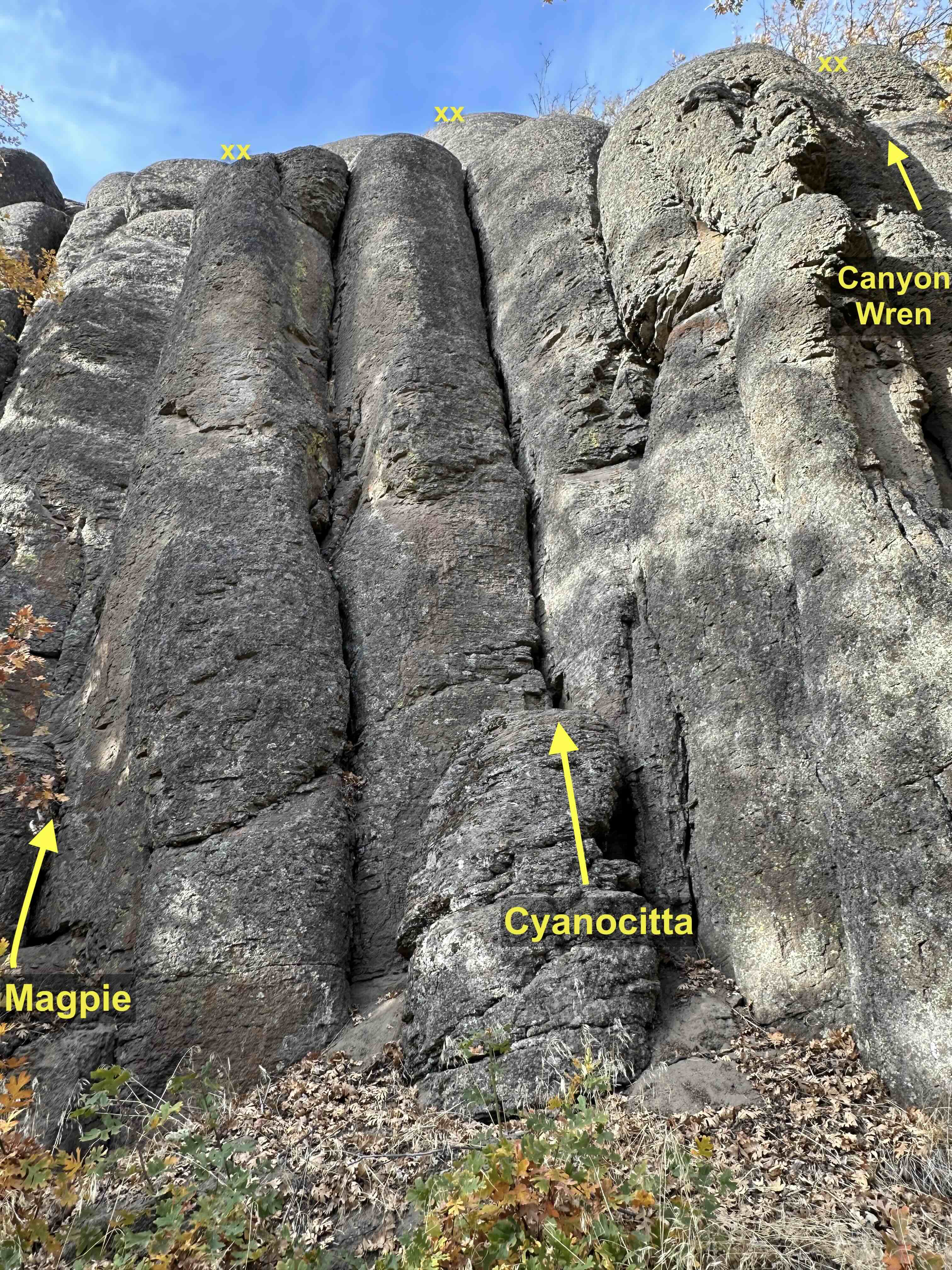
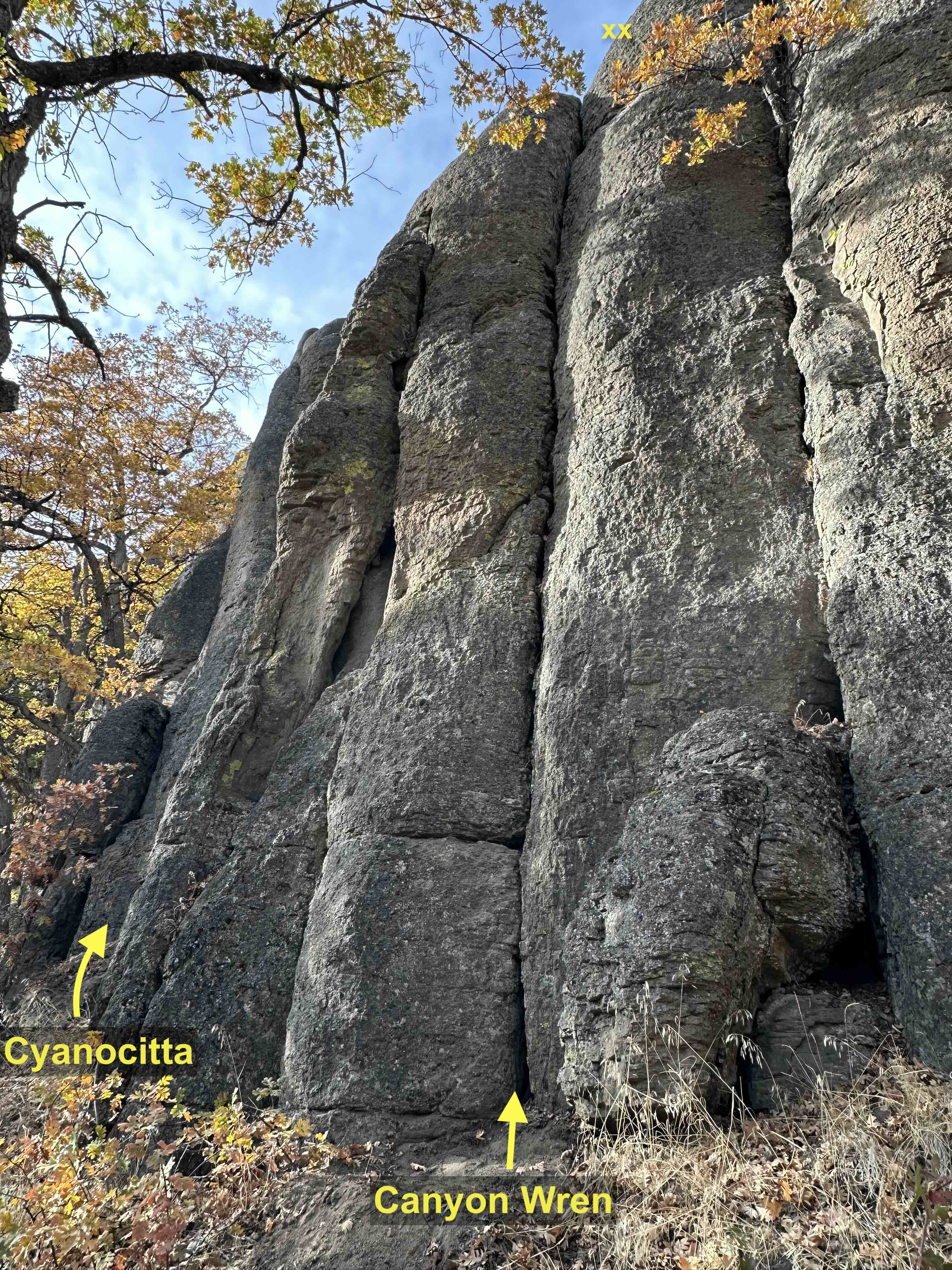
Approach
There is a bit of a rough climber’s trail / elk trail, which starts uphill directly across the road from the entrance to the Windy Point Campground. From there to the established Windy Point Columns cragging routes is only about 0.3 miles, which takes about 15 minutes to walk.
At first, the trail goes up from Hwy 12, gains 270′ in 0.1 miles, to reach the left-most end of the column-formations that make up the row of Windy Point Columns. At that point, the trail splits, with left going to The Oasis, and right traversing along below the long row of columns. To get to the established routes, just follow the columns for another 0.2 miles eastward, until a grove of oak trees where some of the columns match the route-pictures above. I’ve found the two-pairs-of-two tree-trunks by the wall’s base to be an especially helpful landmark to watch for.

Parking
Parking for the Windy Point Columns is imperfect, and does involve some trade-offs. Here’s a few options:
- (Recommended) There’s a river-access trailhead parking lot about 2/10ths of a mile west beyond the Windy Point Campground. (This is what the Google Maps Link and embedded map below show)
- Pros: This is the most confidently-legal place to park: it’s a large dirt trailhead-style parking lot, off of the highway, and with plenty of space for many vehicles.
- Cons: It does require walking along the shoulder of Hwy 12 for ~1000 feet. Fortunately, the south side of the highway does have a lot of space where you can get well off the road and walk along on some gravel, well away from the 65MPH big trucks shooting by.
https://maps.app.goo.gl/QVU4XdSVpVmnqHKt9
- Option 2: Or, 1/10th of a mile east of the Windy Point Campground, there’s a driveway to a cabin that burned down during the Retreat Fire of 2024. Theoretically, you could park in the old driveway to that burned-down cabin, I don’t imagine you’re blocking anyone’s access by doing so. But do so at your own risk. And it’s not a lot of space. You’d still either have to walk along the shoulder of Hwy 12 for a bit, or (maybe better) walk into and through the Windy Point Campground itself, so that you walk out of the campground’s driveway, and only have to be close to Hwy 12 in that moment that you actually cross the road there.
- Option 3: Or, if (and only if) the Windy Point Campground is closed for the season (I think the campground only operates between mid-May and late-September, and is otherwise completely closed during the late fall, winter, and spring), and its yellow gate is closed and locked, you could park one car (maybe two cars, at a stretch) in front of the campground’s locked gate, and then you’ve got no extra walking to do at all. However, do try to not-fully-block the gate, just in case for some reason access is needed while you’re parked there.
Try to be a good citizen of the area, and make sure that wherever you park, you aren’t too obnoxious in doing so, while also keeping yourself safe from the highway-traffic zooming by. I strongly lean towards recommending that river-access parking lot, and walking the south-shoulder of the highway with a wide berth.
Rack / Rope / Gear
Rack: Cams equivalent to Black Diamond sizes #0.3 to #4 would be ideal to have here, perhaps with doubles in the #0.4 to #3 sizes, and perhaps even triples of #1, #2, and #3 if you really want to stitch things up. A #5 is not necessary, but if you had one, it is optional/reassuring on one route, Pika Palmoa. Of course, bring a set of nuts for the good habit, though most placements are cam placements. And bring however many draws you feel like. (The routes are mostly straight, but it’s worth having a few single-length and double-length alpine draws for spots where a route switches which crack it follows.)
Rope: A 60-meter rope is plenty. Of the seven routes established here at the moment, four are 70-feet tall (requiring 45 meters of rope to get up and down), and three routes are just 45-feet tall (requiring a only 30 meters of rope to get up and down.)
Anchors: All of the top-anchors that I’ve installed are two diagonal bolts, connected by chain, with a single large steel ring intended to be rethread-and-lowered-through when the last person cleans a route. To top-rope through your own gear, the smallest & simplest thing would be to clip a pair of lockers, opposite and opposed, to that rappel ring. Or a pair of quickdraws opposite-and-opposed. Or a quad (though if you use a quad, you may want to clip the steel quicklinks that are directly connected to the bolt-hangers. The bolt-hangers themselves are a bit of a tight fit and may triaxially load your carabiners, which is why I think clipping the quicklinks is better.) Or whatever – use your own judgement, and do what you feel safe doing.
Clothes / Temps: (Weather forecast) This crag is south-facing, but also has some partial tree-shade:
- During some hot 70°F September days, I found the crag warm but reasonable, thanks to the tree-shade taking the edge off of the otherwise-direct sun; though I did go through water surprisingly fast, drinking more than 3 liters some days.
- During October, temps were perfect!
- During November, even with the morning starting in the 30’s with frost on the ground, the direct sun made the crag comfortable and enjoyable, though bring a light layer to climb in, and a heavier layer to belay in.
Footwear: The approach is pretty friendly, fairly similar to the Royal Columns. Any old sneakers will do. Bring your comfy crack-jamming rock shoes for the climbing routes. (Flat toes, not too tight.)
Crag dogs? Not recommended. I have observed rattlesnakes in the area. The snakes and I have always given eachother plenty of polite distance, but I cannot say the same for your dog. And beyond the snakes: the dry fall grass in the area forms these little dart-like seed pods that will eagerly inject themselves into socks or dog-fur if either you or your pooch goes off trail for more than a few steps, which you will likely spend an eternity then trying to remove.

