
At long last!! After six years of trying, dozens & dozens of good-weather-windows looked at but ruled out due to some other conditions problem or lack of partners, and four other previous “perfect opportunity” attempts made but turned around: Finally. I have finally climbed that darn couloir, on the weekend of April 13th & 14th. It proved to indeed be the most difficult alpine climb I have done in my life to date.
Previous Attempts
A lot of the story leading up to this is covered in my previous post about it: https://rocknropenw.com/2021/11/25/eldorado-nw-couloir/ After that November 2021 attempt turned around:
- During spring of 2022, I kept an eye on it, but never quite lined up weather and partners at the same time to make an attempt. I kept sending emails to folks trying to get an attempt together all the way into June, before finally accepting it was clearly too late in the season to keep trying.
- During fall of 2022, plans did line up with a good-looking weather-window and partners willing to give it try on November 12th & 13th, 2022. Our bags were fully packed and ready to go that Friday night, but then we got evidence that there was fresh snow on Eldorado’s boulder-field (between 4000′ and 5200′), which would once again make that section a hellish post-hole-between-boulders nightmare, which meant we probably wouldn’t be able to get through it any faster than we did last time, which I think is the key to making the bigger-picture timing on this route work. So we pulled the plug while still warm and cozy at home, without making an attempt.
- During spring of 2023, it felt like we got dealt a really rough hand in terms of weather. I swear there were only two weekends of good weather all darn spring: March 18th-19th, and April 29th-30th. In a stroke of bad luck, those were also the only two weekends I had made prior calendar-commitments on months ahead of time that I couldn’t really bail from.
- As fall of 2023 approached, I felt the lesson I had learned from previous falls was “go earlier”, go before the boulderfield gets covered in snow. All of my previous fall-season attempts had been during November, perhaps I need to try late-October instead. After all, the original first-ascent was done during the month of October. What really solidified this idea was that on the evening of September 30th, I was backpacking to the north of Eldorado, and took this photo:

Eldorado is the central peak in that picture, even if it does look unfamiliar, since this is the less-often-seen northwest face of it, the complete opposite side from what most of us are used to seeing on typical climb that starts on its south-side, and finishes on it’s east ridge. In the photo above, just left of the summit, is my goal: the Northwest Couloir, it can be seen as a sharp dagger of shadow that seems to split the face. Kinda wild that in five years of trying and three turn-arounds so far, this was the closest I’ve come to actually seeing the climbing route for myself. Anyway, what was important to me in this photo was seeing how snow-plastered everything was up at the couloir’s elevation. I was certain the formation of ice in the couloir for this fall had begun. For three weeks, I watched weather forecasts for Eldorado. The upper elevations showed temps below freezing nearly every day, but also daily rises above freezing, which in my experience is ideal for ice-formation, suggesting melt/freeze cycles. I also had evidence that not only was the boulder-field totally snow-free, but also the snowline was was up at 7000′, making much of the approach easier, and the road was even drivable to the normal summer-trailhead to boot! In the third week, we had a high-pressure system, with Friday looking like the best day to go for it. I put yet another desperate mass-email plea for partners out there, and much to my surprise, managed to rally a full crew of nearly everyone I’d made a past attempt with: Ryan, Brian, and Naomi. On Friday October 20th, the four of us tried to go for it, this time with an in-a-day goal, knowing the approach would be way easier, and taking advantage of that to go fast-and-“light”. (Light turned out to be a 38 lb pack, with no overnight gear, but still a rack of both ice & rock pro, a picket just in case, pair of ice tools, clothes & big down jacket for early-winter-temps, etc.) We left the cars at 3:30am, enjoyed sunrise at 7:30am as we crossed the little ridge from Eldo Basin to Roush Basin, but it still took until 11am to reach the col by Dean’s Spire where the rappel was. I was ecstatic to have made it that far, it was farther by far than any previous attempt had been! That’s where things get committing, where we have to rap in to the northwest side, so we discussed, but opted to go for it!! Not knowing exactly how far we’d have to rappel, we tied both 60m ropes together, and I went first. From the bottom of the first rappel I could partially see into that couloir nearby. Unfortunatey, here’s what I saw: https://www.dropbox.com/scl/fi/tbdpd75so64lawhhxrya1/2023-10-20-12.15.43.mp4?rlkey=6ze79z8iahv2s4sxzqbo5cs03&st=jaacqh5w&dl=0


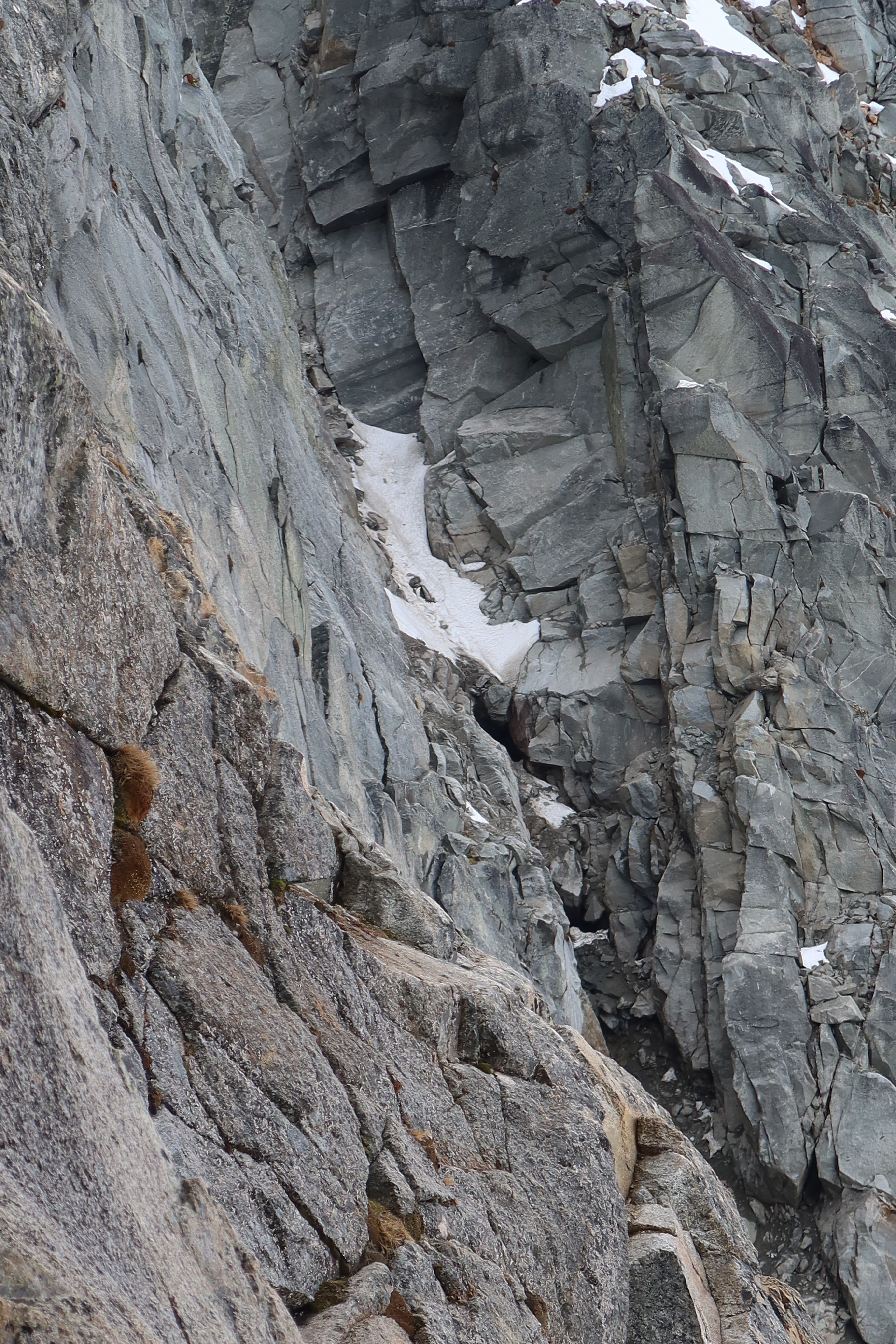
It looked quite melted out, discontinuous ice, recent fresh rock fall. It didn’t look good at all for climbing. So we opted to bail, I re-ascended the rappel, and we retraced our steps out of there. It was at least a beautiful day in the mountains. Here’s the full set of pictures from the trip if you are curious: https://www.dropbox.com/scl/fo/kym2d0qdgrk6twzh4ej51/h?rlkey=bratpxd2vb22b33lzsur0xuv3&st=v0drq0hm&dl=0
I did learn some things about the rappel
TODO: Ack, there’s a lot more I want to write here about this April 2024 return and at-long-last completion, but I keep not-quiet-getting-to-it. 
I’m gonna paste some rough notes below, publish this very-rough-draft, and hopefully come back to clean this up later…
https://www.strava.com/activities/11186059361
https://www.strava.com/activities/11186303840
If I did this route again:
Rack:
Rock pro – In our April conditions, I could get to the rock-walls on either side of the couloir if I wanted to, but it was rare that I saw usable cracks in the rock for pro. Not a lot of cracks appeared to be present in the first place, and the few that existed were either choked with aerated ice, or was there because a piece of rock was flaking off and thus too loose for pro.
Cams BD #0.3 to #1 (preferably BD Ultralights for #0.5 – #1, and Z4s for the #0.3 and #0.4. Yes, there is an “Ultralight” #0.4, but it’s the exact same grams as the Z4, and the Z4 headwidth is better. Will that make a difference on this route? Highly unlikely, but still fun to know.)
Set of nuts – I had BD Stoppers #3 – #13. I only found some occasional nut placements, and mostly for the tiny to medium nuts. If you wanted to shave a bit of weight, you could take out a few of the larger nuts. For example, if you took out BD Stopper #13 and #11, you’d shave 4.2 ounces, or the equivalent of leaving out 4 carabiners elsewhere in the rack.
Slings – I’d recommend 5 or 6 single-slings, and 4 double-slings. Nearly all as alpine-draws, with two carabiners each, since most of the time you’re clipping an ice screw or nut placement. Each pitch has not a lot of pro opportunities, so you don’t need a lot of slings.
Ice screws – 6 or 7. If I had to chose exact lengths, I’d go with something like this for six screws: 7cm, 10cm, three 13cm, 19cm — Mostly the stubbies and shorties will get used, but I always like to have one longer one, just in case. “Blue Ice Aero Lite” are the lightest model of ice screw I’ve found. (Make sure the word “Lite” is in the title to get the aluminum ones, otherwise you might be getting the heavier steel ones. Easy to mistake the two in a hasty online order.)
Pitons – I never ended up finding an opportunity to place any, but I’m sure placement opportunities are out there. If I did it again, I’d definitely still bring pitons, but maybe just two. Like one BD Knifeblade and one BD Bugaboo. Exactly which size probably doesn’t matter.
Pickets – We had three, but would have been happier with four. Nearly all of our belay anchors were just a buried picket in a T-slot, so 3 pickets meant one for the anchor at the bottom of a pitch, then a marginal/vertical one after climbing like ~60ft above the belay anchor, and then one another, say, ~120ft above that when digging another T-slot for the next belay anchor. On some pitches, the only other pro was maybe a marginal ice screw, maybe a marginal nut placement, so having just one picket placed mid-pitch and having to lead 100+ feet above it was pretty heady. Having a fourth picket would have allowed two to be placed as leader-pro, making things marginally less risky, enough so that I’d say it would have been worth the weight. I rather like the 21-inch “SMC Pro Picket”, it’s 11 ounces with the steel cable included.
Keep in mind the rack above is informed by the experience of climbing the route during April, in spring-conditions. I do think the route is likely to have a very different character in fall-conditions, if you’re lucky enough to find it “in” during late-October or November, with ice formed but not yet buried by snow. I imagine in those conditions, you’d want fewer pickets, and maybe more ice screws.
Ice tools & crampons
A pair of Petzl Sum’tecs proved to absolute perfect tools for the job, I was very very happy that I had brought them, I would have wanted nothing more and nothing less. They did very well at transforming between the two different modes that I need, and still doing each mode really well. If there was solid ice, slide the trigrest to the bottom, and it’s an ice-tool with a sharp enough pick and decent enough weight behind the swing to make solid sticks in the ice that I felt I could trust my life to. Then in the many long steep snow sections, slide the trigrest to just a finger-width or two below the top, leaving the shaft completely free of protuberances, ideally set up for plunging vertically in snow. For the steep snow sections, where were a lot of this route, having both tools firmly & deeply plunged in the snow was crucial to me leading with confidence.
I also own a pair of Quarks at home, but was glad I didn’t bring them, because the shaft doesn’t plunge as well. I do have the older-style Quark, from before the Griprest had the ability to flip-up on the fly (on mine the griprest can be removed, but you have to do so at home with an allen-key, and even then it still leaves a protuberance.) Maybe the newer Quarks would have been fine, I don’t know.
(Yes, Petzl Gullys are notably lighter, and maybe could work for this, but in real ice the swing feels a a little too light to me, and in snow, I tend not to like the cut-off-shaft style for bottom spikes, as I find they tend to fill with snow and become harder to plunge vertically. Is it possible to climb the NW Couloir with a pair of Gullys? Yes, absolutely, someone out there with a bigger risk-tolerance than me will do it, but personally I found carrying the weight of the Sum’tecs very reassuring and very well worth it.)
Crampons – I made a mistake here. For context: remember that our trailhead pack-weight was nearly 60-pounds, with ice climbing gear, winter overnight gear, and a ski-touring setup carried on the pack. There’s a strong reason to bring the lightest-possible-version of everything, and I have done everything I can to do so. I tried to save weight on every gear choice. Crampons were included in that list. I had brought Petzl Irvis Hybrid crampons a couple years ago, which have a steel toe-piece and an aluminum heel-piece, and dyneema string holding them together in place of a traditional metal center-bar. When I bought them, I was fairly skeptical initially of their ability to front-point and climb ice, so I tested them out. The Mountaineers Program Center at Magnuson has a foam-wall, effectively an ice-climbing-simulator, where you can climb the vertical foam with toothless ice tools and crampons. I took my Petzl Irvis Hybrid crampons there, practiced on the foam wall, and found I could front-point into a vertical wall with those crampons with surprising confidence, I could solo up and down the wall without a belay. (Not that I recommend doing so. Don’t solo above a concrete floor with a little plywood over it. Do as I say, not as I do, lol) Point is: I ended up having confidence in the crampons from that test, they had proved themselves apparently ice-climbing-worthy, and they were almost a full pound lighter than my other ice-climbing crampons. But at the last minute when packing for this trip, I needed to size them to my ski-boots instead of my mountaineering-boots, and I don’t think I got them quite as tight. When I was out there on-route in the NW Couloir, the toe-pieces ended up pivoting and moving around on my ski boots. Loose crampons meant I couldn’t trust my feet, and not being able to trust your feet while ice climbing is foundation-shaking, both figuratively and literally. I still led the Alpine Ice 2ish / 3ish sections, even with the loose crampons, but it made it feel a lot harder than it had to be. Ugh, they’re so much heavier, but honestly I would have been better off sticking with my Grivel G12’s or Petzl Sarkens instead, both are much much more reliable crampons for leading alpine ice & steep snow. Yes, they’re a lot heavier on the approach, but I would have moved faster and with more confidence on route if I had actually brought the reliable tool for the job.
Grivel G12 – 1006 grams
Petzl Sarken – 902 grams
Petzl Irvis Hybrid – 570 grams
Time
To climb this route in a single day with no overnight, you either need to be super-human, or have been lucky enough to have gone during November 2019, when a very rare set of weather circumstances made for unusually-good approach conditions, and also unusually-good climbing conditions, allowing for car-to-car times that would not have otherwise been possible.
7h30m – car to Dean’s Col
~9 hours to rap in, and climb the route out
6 hours – summit to car
So outside of those unusually good conditions that happened one-time in November 2019, I would expect single-day car-to-car times to be about 22 hours. And if anything went wrong…. yikes. Being up there in winter temps with no real overnight gear sounds way too margin-less to me. Definitely not something I’d recommend. Even if you did stay on-schedule, a 22-hour day would be pretty mentally brutal if you did it in November when there’s ~10 hours of daylight and ~14 hours of night.
 Rock n' Rope Northwest