What to know about Climbing Bolts as someone who clips them: Inspecting them, and what to do about “bad bolts”

If you clip bolts outside, here’s some base knowledge you should have about the bolts you are clipping, and what to look for.

Keep in mind that almost every bolt you clip outdoors could be described as “abandoned hardware on public land.” You should be treating them with the same mindset you use for webbing rappel anchors that you happen to come across. Someone put it there, maybe recently, maybe long ago; maybe they used great materials, or maybe they used materials that weren’t designed to last; maybe the years have been unkind to the material and it has degraded. (For webbing rappel anchors, “degraded” could be UV-light bleaching, or getting chewed on by a rodent, etc. For bolts, the concern is rust, or mechanical parts loosening.) In any case, the person who put it there is long-gone, and it is your responsibility as the person who is here right now, about it use it right now, to be able to inspect it a little bit, and be able to make a judgment call about how much to trust it. Yes, there is a difference between webbing rappel anchors and bolts, in that webbing rappel anchors are quite simple to replace, and anyone carrying a bit of spare webbing or cord can do so; whereas bolt-replacement-work is highly technical & involved, requiring specialized-tools, specialized-skills, and an immense amount of time. But at least being aware for the state of a bolt is still an important skill, and may change how you choose to use it, or what you would tell others about it, even if you cannot change the bolt at the time that you’re using it. Hopefully, this post gives you a little more awareness about what you could/should inspect, as a user of existing bolts.

  1. Parts of a bolt
  2. Metal types
    1. Identifying Plated Steel vs Stainless Steel
    2. Galvanic Corrosion
    3. Another Concern with Plated Steel: Zinc Leaching
  3. Know some common sizes
  4. A few common bolt-types, just to know
  5. Recognizing “bad bolts”
  6. It’s a spectrum: How “bad” is that “bad bolt”?

For even more information, you could check out HowNot2’s bolting bible, which is an absolutely phenomenal resource, and probably more accurate than anything I describe here. But I also know it’s a lot, more than someone who just clips bolts probably wants to read. I’m hoping my page here is a less-overwhelming amount of information to absorb, targeted at an audience that clips bolts, but isn’t in the business of placing bolts.

Parts of a bolt

As a climber, you are used to seeing the part of the bolt that is outside of the rock, such that the bolt looks something like this:

However, to have a better awareness & understanding of the bolts you are clipping and trusting your left to, you should at least be able to name & identify the separate parts you are seeing here: the bolt’s hanger, vs shaft, vs nut.

Continue reading

Mountaineers Club Climbs desperately need a philosophy of “More!”

My goal in the Mountaineers, more than anything else, is for it to be easier for people to sign up for climbs. (Well, really any activity, but climbs happen to be my personal area of interest.) I want to see more climbs posted. I want to see more people getting out, social mixing, and doing active things together in the outdoors, and just generally having positive experiences. I want this both for more people, as well as for already-engaged people more often. I imagine we all share these goals.  It’s often easy to agree on goals. Often times where framing & conversation gets more complicated is in the how —> “How do we make strides towards these goals?” At the really boiled-down core, my philosophy here is a philosophy of more, not a philosophy of less.

Continue reading

Advice on using the Edelrid MegaJul belay device

  1. Introduction
    1. Why use an assisted-braking device?
    2. Why specifically the MegaJul?
    3. The downside here
    4. What To Buy / Some Specific Gear Recommendations
  2. Core Belaying Skills
    1. Notice the Gap!
    2. Baseline
    3. Belaying for Top Rope
    4. Lowering a Top-Rope Climber
    5. Belaying a Lead Climber
  3. Rappelling
    1. Standard Rappelling – with Assisted-Braking Disabled
    2. A bit niche: Rappelling with Assisted-Braking Enabled
  4. Belaying a Follower (From Above, Plaquette-Mode)
    1. First, be aware of a danger that affects ALL guide-mode / plaquette-mode style devices
    2. The MegaJul-Specific Setup for Belaying From Above
  5. Advanced Skills
    1. Advanced Skill: Lowering a Follower
    2. Advanced Skill: Raising a Follower
    3. Advanced Skill: Switching mid-rappel to rope-acension

Introduction

Why use an assisted-braking device?

With any belay device, you should never let go of the brake strand.  But if someone fucks up, or the belayer is injured, then belay devices with assisted-braking provide an additional layer of safety towards not-dropping the climber.

The moment that really convinced me personally was long ago in my climbing career, when I was climbing at the gym with a relatively-new belayer who was notably lighter than me. I took a fall, and that particular belayer was lifted of their feet, and slammed into the wall, and in that split-second, reflexively and without thinking, they put their hands up to take take the impact of hitting the wall. Both hands. Neither hand remaind on the brake strand. Fortunately, they were using a belay device that did have an assisted-braking feature, and it had happened to engage, catching me. Thank goodness the incident had no physical consequences, and it was thanks to slight extra margin of safety that assisted-braking layers on. The only consequences were emotional, the belayer was indeed mortified that they had let go of the brake strand–of course they knew not to do that, and they felt horrible that it had happened. But I also understand that it had all happened so fast & suddenly, that it had nothing to do with what the belayer knew, or thought, or chose; it happened fast enough that there was no knowing, no thinking, no choosing; just reflex. My takeaway is that humans should strive to do the best job they possibly can, but we should also acknoldge that humans inherently imperfect and that mistakes are inevitable, so it is better to engineer in systems that have at least some fault-tolerance. i.e. strongly prefer that what you get from your belayer is both excellent belay technique, and an assisted-braking belay device. One-in-a-million things do happen, all you can do is try to change the denominator.

I’m also going to go out on a limb and make a prediction for the future of climbing:  Although belay devices that lack assisted-braking are common today (e.g. Black Diamond ATC, Petzl Reverso, etc.) I strongly suspect that in 50 years, climbers will look back at belay devices that lack assisted-braking the same way we currently look back at hip-belays in the 1960’s, thinking “Geez, that was so risky!  I can’t imagine taking a risk like that!”  That new realization hasn’t yet swept the climbing community, but I predict it’s coming, so why not get ahead of it and add that extra margin of safety?  If you want to really geek-out on this, there’s a fantastic & very long article from the AAC on this topic. Also, some gyms have already taken this step!

Why specifically the MegaJul?

I care more that you use some belay device with assisted-braking, any device with assisted-braking. I don’t care so much which specific assisted-braking belay device you choose. For example, if you want to belay me with a Petzl GriGri, that’s fantastic, I will be perfectly happy!! Bring that GriGri to the gym, the crag, or the alpine, it’s great in all settings! I certainly do know a lot of fellow climbers who do indeed carry their GriGris into the alpine for any climbing they are doing. However, pretty much all climbers care about weight, and often ask the question: “But what is the lightest thing that can work?” The GriGri’s most notable downside is that it weighs 175 grams (or 6.17 ounces,) compared to a MegaJul, which weighs 75 grams (or 2.65 ounces.) If for some reason you carried two MegaJuls, together they would still be ligther than one GriGri. The GriGri’s second big downside is that it cannot do normal rappels, on two strands of rope. (Yes, you could do single-strand rappels with the GriGri, but the extra setup to make every rappel a safely a single-strand rappel means you’ll eventually lose on speed.) Everyone I know who brings a GriGri into the alpine, also chooses to bring a second belay device which for them is dedicated to rappelling. A Black Diamond ATC is great for rappelling, but carrying both a GriGri (at 175 grams) and a Black Diamond ATC (at 80 grams) is a lot of weight to achieve both assisted-braking belaying and normal rappelling; whereas a single MegaJul (at 75 grams) can do everything a Petzl GriGri and Black Diamond ATC combined can do, and is the lighest thing on the market that can do so.

The downside here

The biggest downside of specifically the MegaJul is that it does have a steeper learning-curve than most belay devices. Since it takes a while to learn the nuances of working with it smoothly, many people try one out for a short time, and during those early times they use it before they’ve learned the nuances, it feels a jerky & grabby & difficult. Many people aren’t willing to stick with it long enough to get through the learning curve, and they blame the device (“Oh the device is jerky!”, despite the fact that it’s not jerky in the hands of an experienced user) rather than take on a learning mindset (“How can I hone my skills so that I am able to utilize this device more smoothly?”) Anyway, I do sympathize, the learning curve for the MegaJul is indeed notably longer than most popular belay devices, and it does suck to be within the learning-curve rather than past it.  You need to practice the parts of this article that are relevant to you and your type of climbing.  If you’ve never used this style of belay device before, you are going to be awkward and clunky the first few times you try these skills, and that’s okay, that’s normal.  But if you stick with it, keep practicing, build muscle memory, and notice the little details that make things smoother, the payoff is that you’ll have a tool that does everything an ATC does and everything a GriGri does, for only 75 grams.  And your partners will appreciate knowing they’re belayed with an assisted-braking belay device, as long as you have developed your skills to operate it smoothly.

I have learned to operate the MegaJul very smoothly, and I’ve found it to be an ideal & effective device for me. I’ve gotten past it’s learning-curve, and I’ve clearly learned some nuances & tricks that make it work so well for me. I really wish I could communicate those nuances to you, to make the learning curve a little shorter for you. This article is my best attempt to capture some of those nuances.

What To Buy / Some Specific Gear Recommendations

TODO: Why specifically the MegaJul, and not he GigaJul or just the Jul.

TODO: talk about carabiner-choice

Core Belaying Skills

Notice the Gap!

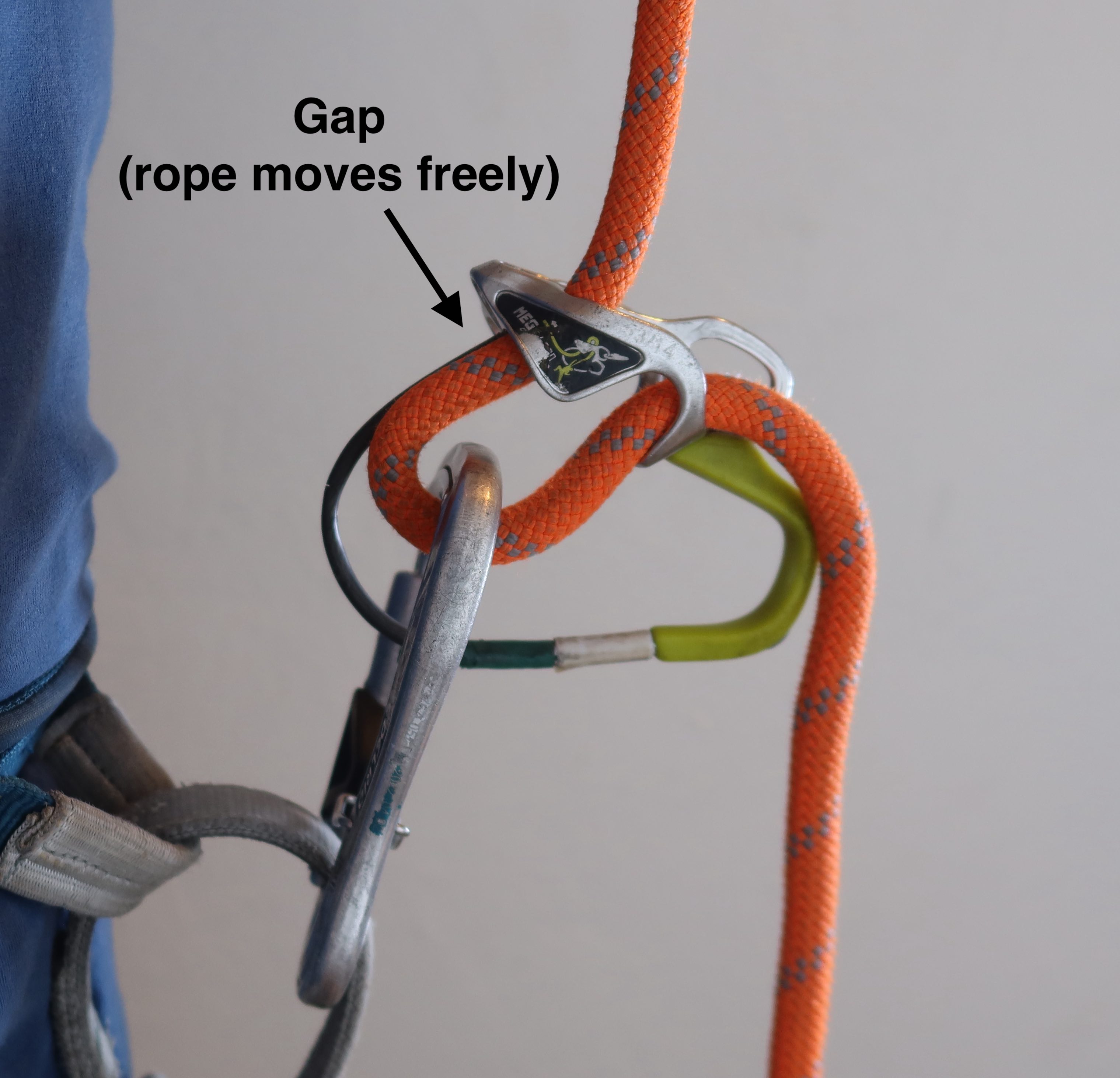
The first thing you should learn about the MegaJul is how it’s accomplishing it’s assisted braking. It does so via the geometry of the device, with that notch in the bottom. When a carabiner gets sucked up into this notch, it pinches the rope. Therefore, the difference between rope moving freely through the device, vs being pinched, is based on whether there is a gap of open-space between the MegaJul and the carabiner or not.

Baseline

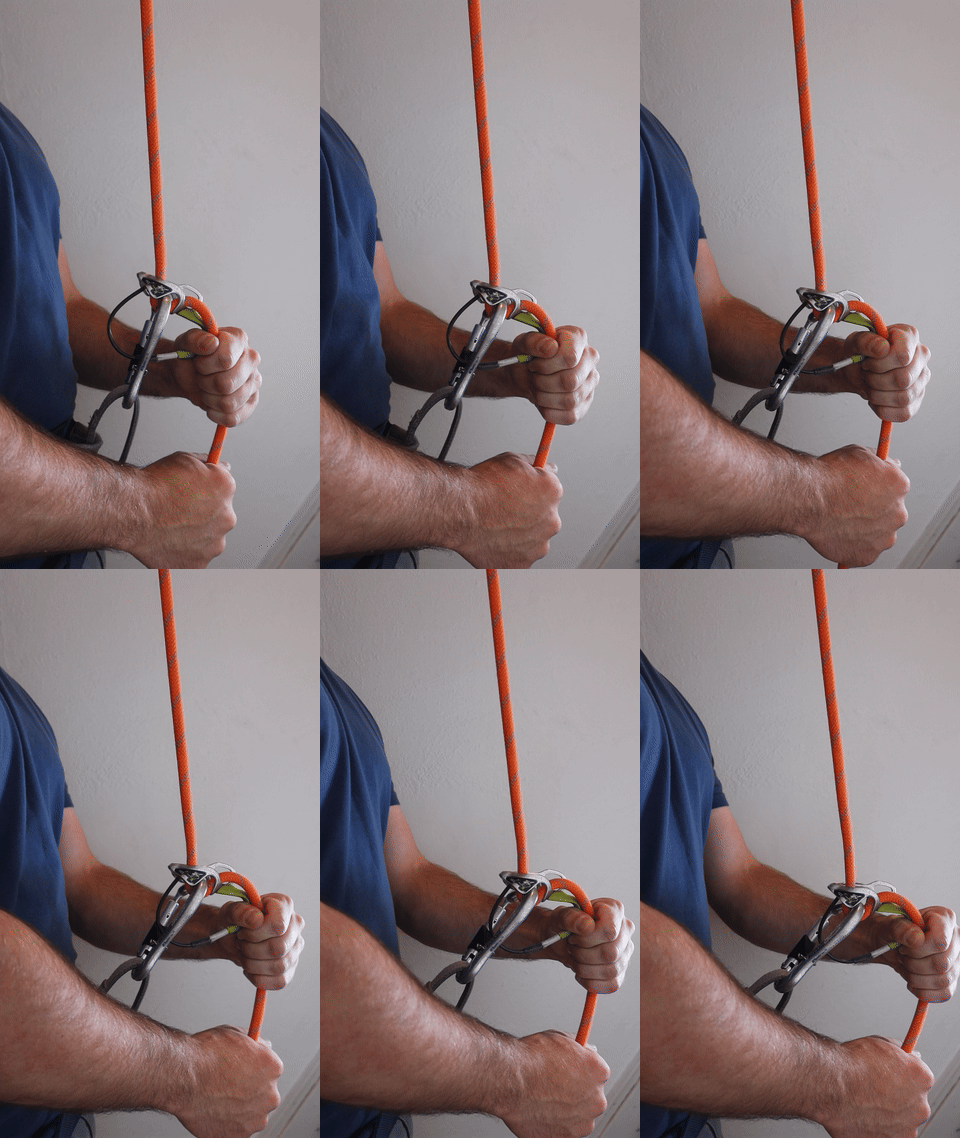
When belaying off of your harness, Edelrid advises that any time the rope isn’t moving but is unweighted, you should assume the “baseline” position, which is the ideal ready-stance for the belay motion that’s likely to happen when the rope does move. The baseline position involves a brake-hand with four fingers closed around the rope, and the thumb of that hand through the lime-green thumbloop. A slight forward tension from your thumb both holds the device up to create the gap between the device and the carabine, and pulls the MegaJul so it’s pitched 90-degrees forward, such that the mouth of the MegaJul pointing forward, away from your belly-button. This position both allows the rope to move freely when you choose to move it, and is also the position that’s most likely to cause the assisted-braking to engage quickly and closest-to-automatically if a fall from the climber jerks the rope upward.

I’ve noticed that I use two versions of the “baseline” position, depending on if it’s top-rope climbing (and the likely next movement is reeling rope in) or if it’s lead-climbing (and the next likely movement is paying out slack for a clip or upward movement.) The only difference between these two versions of baseline is where I put my secondary hand: when top-roping, I rest my hand high on the rope, so it’s ready to pull down. When lead-belaying, I rest my hand low, just barely above the MegaJul itself, so it’s ready to pull up.

Belaying for Top Rope

Belaying for top-rope with a MegaJul use the standard PBUS technique that’s taught for nearly all belay devices these days. I assume you already know PBUS, but jus tin case, here’s an excellent 4 minute video demonstrating it: https://www.youtube.com/watch?v=FCUJrXSKWrw Just do exactly that, but with a MegaJul.

PBUS: Pull, Brake, Under, Slide

Tips for smoothness:

  • Note that the gap is maintained throughout, so the rope is free to move.
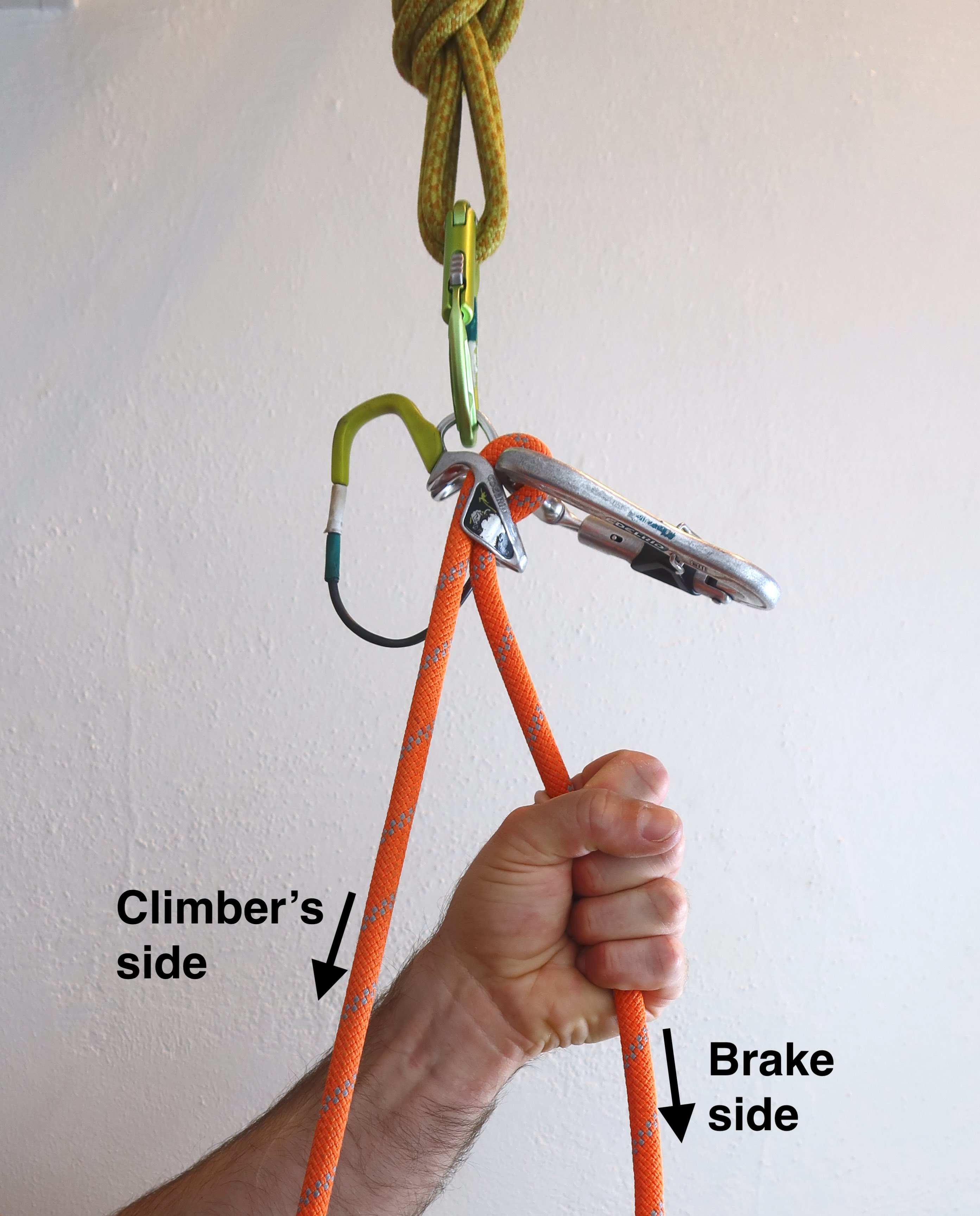
  • Simultaneously pull rope the climber’s-side rope downward at the same time as the brake-hand is pulling rope through the device, so that the subsection of rope passing through the MegaJul is never in tension during this motion.
  • If you feel the device “grab”, it’s because the gap got closed. A useful skill to practice is getting your thumb back in the thumbloop without having to look at it, so that you can pull up, re-create the gap, and get back to smooth rope movement quickly.
  • If your climber pauses and you’re no longer pulling in rope, go back to baseline, with your thumb in the lime-green thumb loop. However, you don’t need to return to this baseline unless the rope stops moving. If your climber is climbing as fast as you can belay for the entire route, you may never put your thumb in the thumb-loop during that top-rope belay (until the moment the climber needs to lower.)

Lowering a Top-Rope Climber

The key to providing a smooth lower with the MegaJul belaying from your belay loop is to push forward with your hand that has a thumb through the thumbloop. Push forward (away from your belly-button,) and possibly even a little bit downward (angling the forward every-so-slightly towards the ground.)

Avoid lifting the device upward. Yes, lifting the device upward will re-open the gap, and allow the rope to run freely, and some other instructionals about the MegaJul will even tell you to do that. However, if you life the device upward and re-open the gap, the rope will run quickly for a split second thanks to the gap, in fact quickly enough that it’ll suddenly re-close the gap too, suddenly slowing the rope, at which point since your hand is still applying a lifting force the gap re-opens… you see how this leads to a bouncy & jerky lowering experience. So to lower, don’t lift the device upward, instead push it forward.

As you push the device forward, the MegaJul will pivot against the carabiner just enough to let the rope start to move a bit. Find that sweet spot, and try to hold you hands there. I try to half-control the lower with the angle of the device, and half-control the lower with the firmess/looseness of my grip on the rope.

For bonus points: you can guard the spot on your hand that would feel the most rope-friction (the spot at the base of your thumb that the rope would curve over just before it enters the mouth of the belay device) by carefully positioning the lime-green thumbloop plastic to sit right there, thus having the highest-pressure part of the rope run on top & parallel with the plastic, rather than on your skin at that point.

Belaying a Lead Climber

Belaying a lead climber uses all the skills you already know for belaying a top-rope climber, and then adds the need to pay out slack quickly at times (either for the climber moving upward, or going for a clip.)

As with all devices, when pulling slack, your brake-hand stays on the rope, but loosens it’s grip slightly, just enough that your brake hand acts as a tunnel for the rope to pass through. The key to paying out slack is to maintain the device’s gap the whole time by actively pulling up with your brake-hand’s thumb on the thumb-loop. As your secondary hand pulls slack through the device to give to your climber, that pull is creating tension in the subsection of rope within the device, and that tension will try to close the gap, which would pinch the rope.

Another thing I find key to lead-belaying with any belay device: always immediately reset your secondary hand to be just-above the device as quickly as possible. That reset of the hand puts you in the position where you’re ready to pull again, and give a second arm-load. If you don’t intentionally practice this and build a muscle-memory around doing this, the unfortunately-intuitive thing that people otherwise do after pulling an armload of slack is leave that secondary hand out there fully extended, where it’s not ready to pull again. Then, when the next armload of slack is needed, they’re behind, they have to move that secondary hand close again before they can start pulling another armload.

This, especially, takes deliberate practice to get smooth at doing reliably and quickly. Put some time into practicing it!

Tips for smoothness:

  • To repeat the key point above: Maintain the gap! If the gap closes, assisted-braking will engage and stop you from paying out slack until you re-open the gap.
  • Rope preparation is also key! Have a well-flaked rope, so that you do not end up with any unexpected tension coming from trying to pull a tangle out of the rope pile, as that tension will make it likely that the gap closes.
  • Anytime I have a free moment while lead-belaying, I pull a few armloads of slack out from the pile of rope and drop them by my feet, just to make sure that the upcoming rope which I’ll need to pull does indeed pull freely. (Obviously: pull these armloads out with your secondary hand or something; you are not ever letting go of the brake-hand to do this.)
  • Practice, practice, practice! You’re not going to be smooth at this at first, but smoothness will come in time, as long as you actually put the time in. At first, you could practice at home by flaking a rope in your living room, then imagine you’re giving someone a lead-belay, and practice paying-out slack through the MegaJul simply into a pile on the floor. Later, when you’re going to give a climber a lead-belay with the MegaJul for your first time, talk about it with them before they climb: it would make sense for them to lead something juggy & easy-for-them that they feel totally confident on while you’re still working on getting smooth with this device, where they’re comfortable pausing for a moment if you accidentally short-rope them. After you’ve gotten some deliberate practice in and become smooth, then the MegaJul is an excellent belay device for your partner to try leading that project of theirs at their limit, but you’ve gotta put in the practice before that.

Rappelling

First, a brief soapbox that’s not specific to the MegaJul: For any & every rappel in a climbing-context, with any device, I strongly advocate for always following Rob’s Three Rules for Rappelling:

  1. Always put knots in the ends of the ropes. (A triple-fisherman, or barrel-knot, in each rope-end is a great choice.)
  2. Always use a system that will stop if the rappeller lets go. (An auto-block is the most common answer. Receiving a firefighter’s-belay is another valid solution.)
  3. Always test before you trust. (Before unclipping your PA, make sure there is slack in your PA, and put your weight on your whole rappel setup, then unclip the PA.)
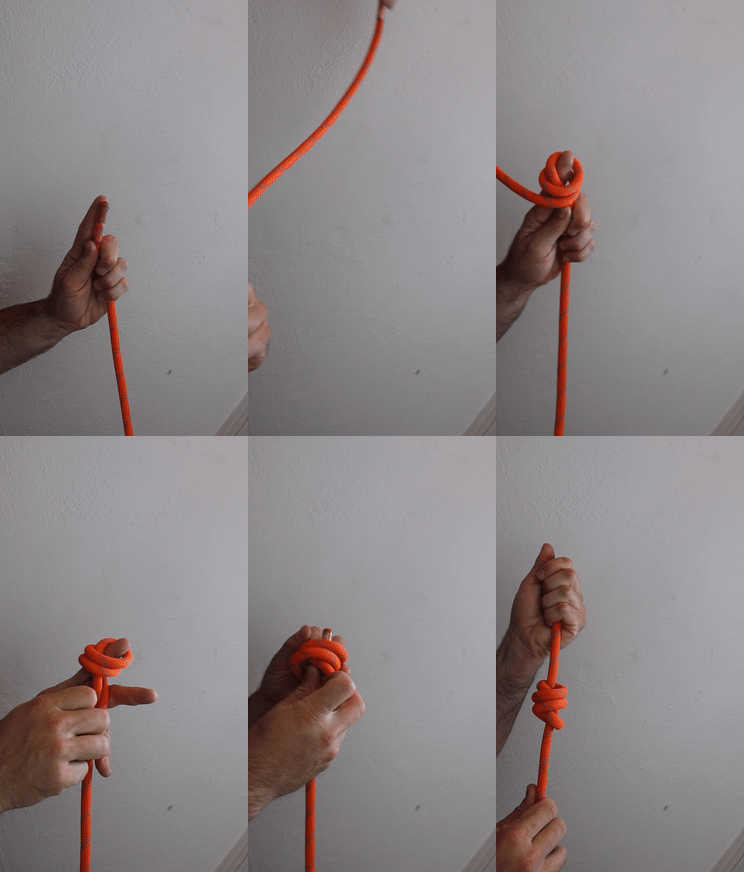
Triple-fisherman’s knot, barrel knot, stopper knot; whatever you want to call it. Just make sure there are indeed knots in both ends of your rappel ropes. This is not a MegaJul thing, this is a general rappel safety thing. In terms of speed: I notice that it takes me less time to just always automatically tie a stopper knot without questioning it, than it would for me to pause and think “Do I really need a stopper knot on this rappel…?” Also, here are even more thoughts on safety in practice.

Standard Rappelling – with Assisted-Braking Disabled

With the MegaJul, the rappel setup that I both recommend & use the most is an extended-rappel, in a setup that results in the MegaJul’s assisted-braking-feature being disabled (so that it acts just like a Black Diamond ATC or Petzl Reverso would,) then adding an autoblock friction-hitch to satisfy Rob’s Rule #2. This is essentially a vanilla extended rappel setup, just like what’s shown in this video, except done with a MegaJul. Any time I’m doing multi-pitch rappelling, this is the setup I use.

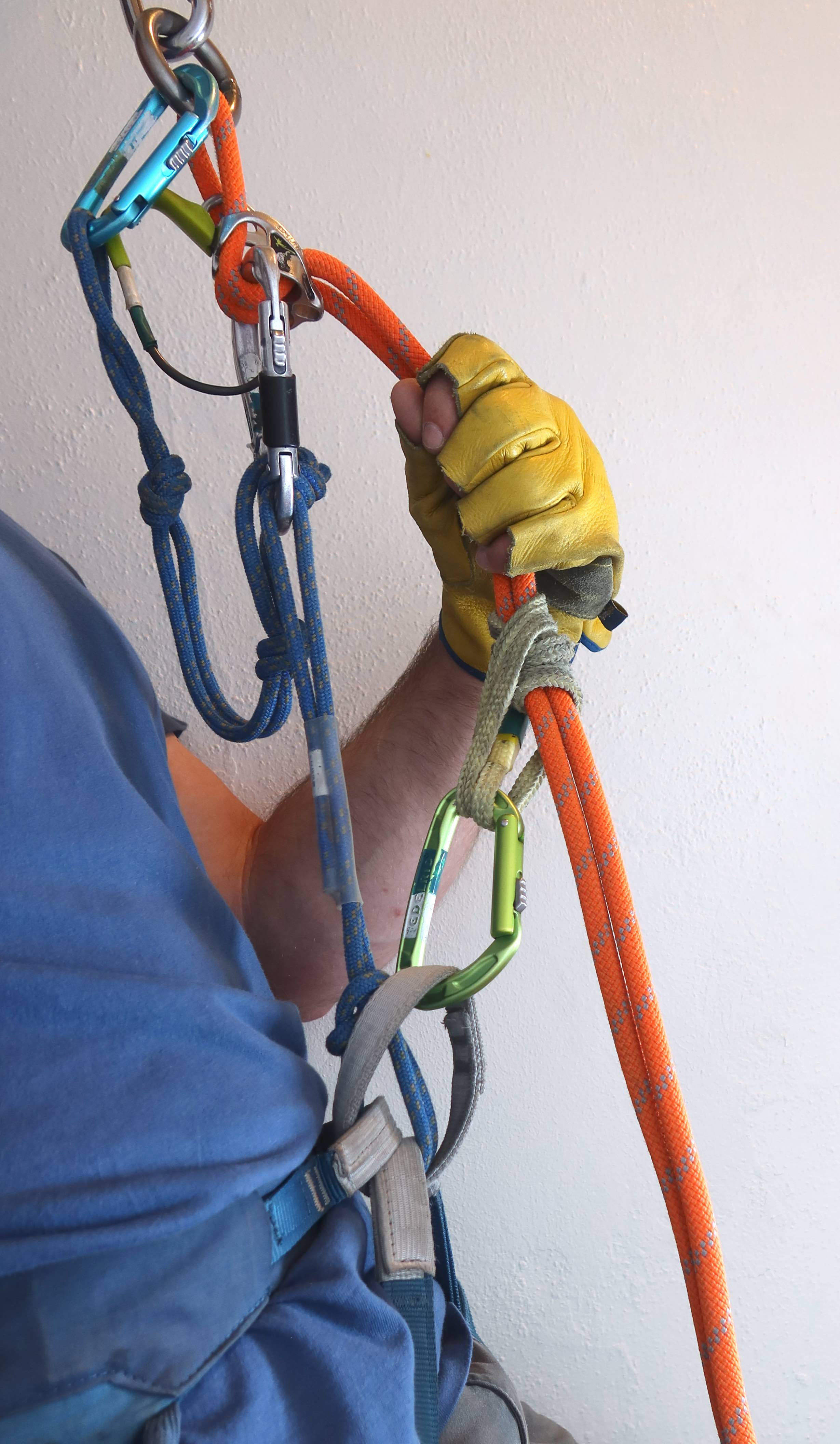
The key to disabling the assisted-braking is positioning the lime-green-thump-loop Up and In. Notice how the device has been rotated 180° around the yaw-axis, so that the green thumb-loop points inward towards my own body, making the thumbloop opposite from the brake-hand-side of the rappel rope.

Extended rappel with the MegaJul set up so that assisted-braking is disabled. The gray webbing with the black stripe is a Personal Anchor here, with a knot it it that’s clipped to form the rappel extension.

Here’s a slowed-down step-by-step on how I set up the MegaJul for rappelling with the assisted-braking disabled:

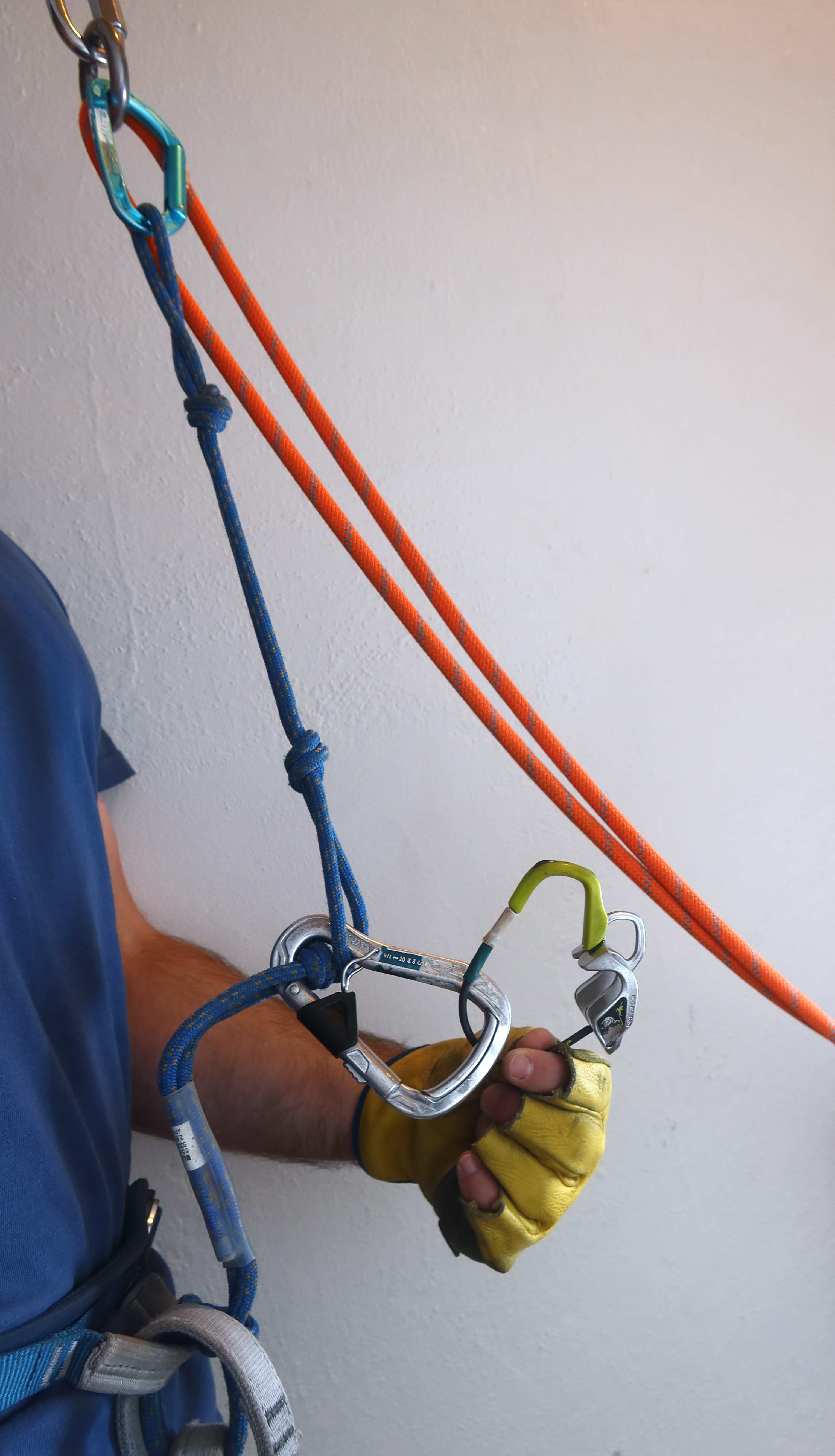
#1. Clip my Personal Anchor to the rappel anchor. (In this photo, the blue cord, and blue locking-carabiner, are my Personal Anchor.) Clipping the rappel-ring itself is ideal if there’s space. Clipping low on the anchor like that sets you up to have slack in your PA, and you’ll need slack in your PA in order to proceed with the setup, and the slack is also helpful later when you test that your final rappel setup holds weight. (Sorry, the slack isn’t shown well in this photo.) Having slack in your PA works best if the rappel anchor is somewhere you can stand comfortably, keeping your PA unweighted. If, however, you’re at an anchor where there’s a poor stance, and you must hang from the anchor, then you’ll need to use either a second PA, or a quickdraw or short sling, that’s clipped somewhere higher on the anchor that does hold your weight, so that your original rappel-extension PA remains slack. (And for those who are curious: what I’m using as a PA here is a “BlueWater Sewn Prusik Loop“, 6.5mm diameter, 44-inch loop length, which I’ve connected at my harness hard-points with a bowline-on-a-bight (a girth-hitch also works and is simpler, but I like that the bowline-on-a-bight doesn’t squeeze the hardpoints together), and then I’ve tied a series of overhand knots in the loop to create multiple length-options for clip in points. This just happens to be the PA I’m using in these photos, you can use any other PA or anything you’d like to create the rappel extension, there are a thousand different right-answers for creating rappel-extension out there, and I simply happened to pick this one to illustrate with here.)

#2. Attach a locking carabiner to your rappel extension. Put the MegaJul on that locking carabiner, so that it’s ready for later, but don’t necessarily do anything with the MegaJul yet. For neatness points: make sure the lime-green thumb loop is UP and IN when you clip it to that locker.

#3. Put an autoblock hitch on the rope, and clip it with a locking carabiner to your belay loop. By putting the autoblock-hitch on first, it can hold the weight of the rappel ropes for you, giving you unweighted slack to work with above the autoblock, which makes the upcoming steps easier. (If you’re curious: the green locking carabiner shown here is an Edelrid Pure Slider, a favorite of mine since it is a very lightweight auto-locking carabiner, very quick to open & close, which helps with efficiency. Also in this picture, the material I’m using for an autoblock happens to be a “Sterling Hollowblock”, the 13.5-inch one, but you could use any hero-loop / prusik-loop. I very frequently use simply some 6mm accessory cord, originally cut as a 4’3″ length of straight cord, then tied into a loop with a double-fishermans knot, which results in a loop that’s ~15″ end to end, which I find to be an ideal size.)

#4. Next, it’s time to push the pair of rope-strands into the MegaJul, and clip them with the locker. Pay careful attention to the positioning of the MegaJul’s thumb-loop here: the thumb-loop should be UP and IN, such that the brake-strands of your rappel-setup are on the opposite side of the device from the thumb-loop.

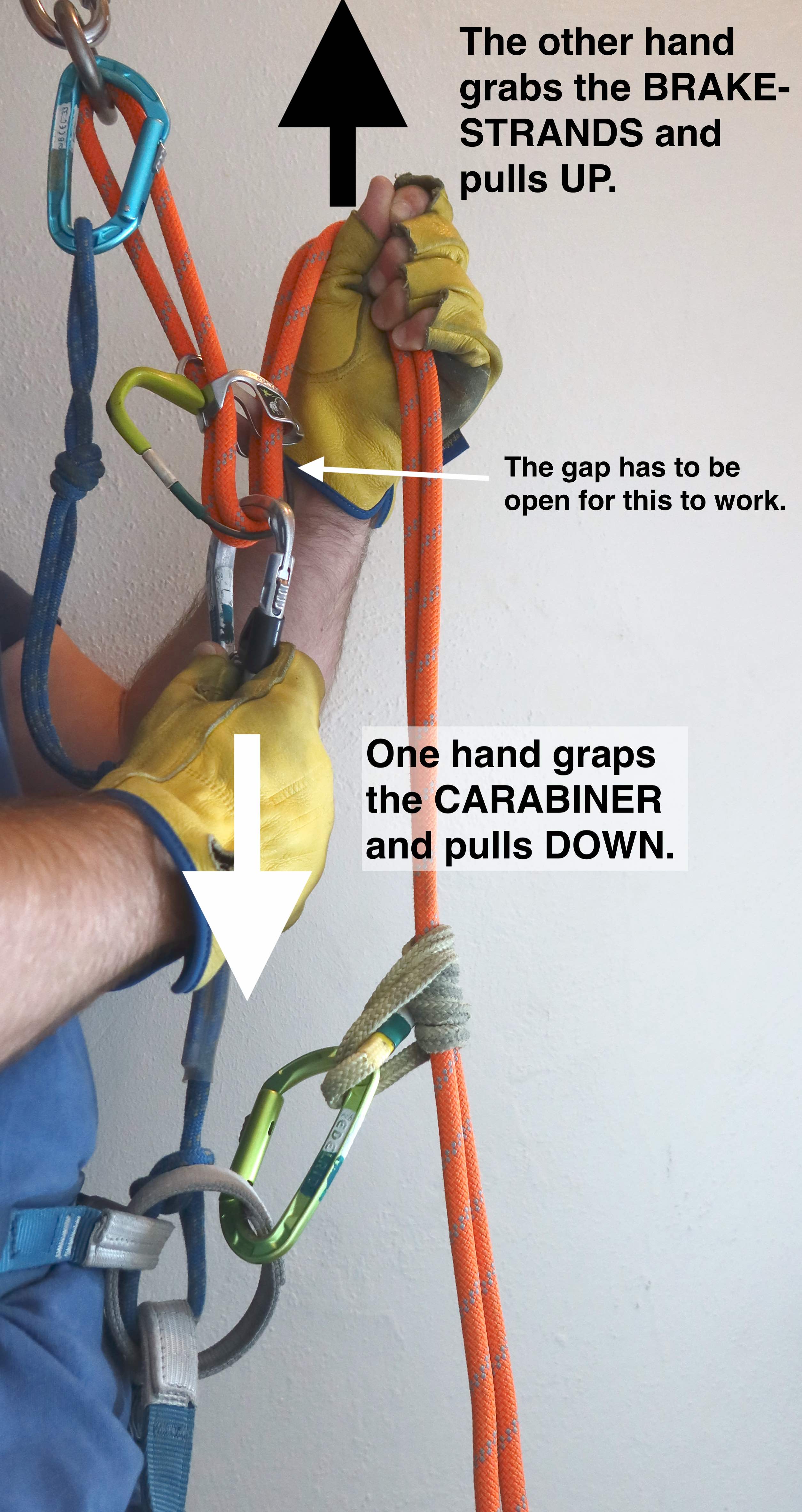
#5. Okay, you’ve built your complete rappel setup, but you still need to test it. The point of the test is to simply verify that the rappel setup holds your weight and stops automatically, before you unclip the safety of your PA. You need quite a bit of slack in your PA to be sure that you’ve actually tested that it is the rappel setup holding you, and not some tension in your PA. In order to create as much slack as possible in your PA, you’ll need to move your rappel device backwards up the rope, getting your rappel-device (the MegaJul) as close as possible to the anchor’s rappel ring. The first small-step to moving the MegaJul backward on the rope is to lift it, and re-create the gap, so that movement will be possible.
#6. Once you’ve created the gap, and movement is possible, then take one hand and grab the locking-carabiner, and pull down, and take the other hand and grab the brake-strands, and pull up. As long as the gap is open, this will smoothly pull rope backwards through the MegaJul, getting the MegaJul up as close as possible to the rappel-ring.

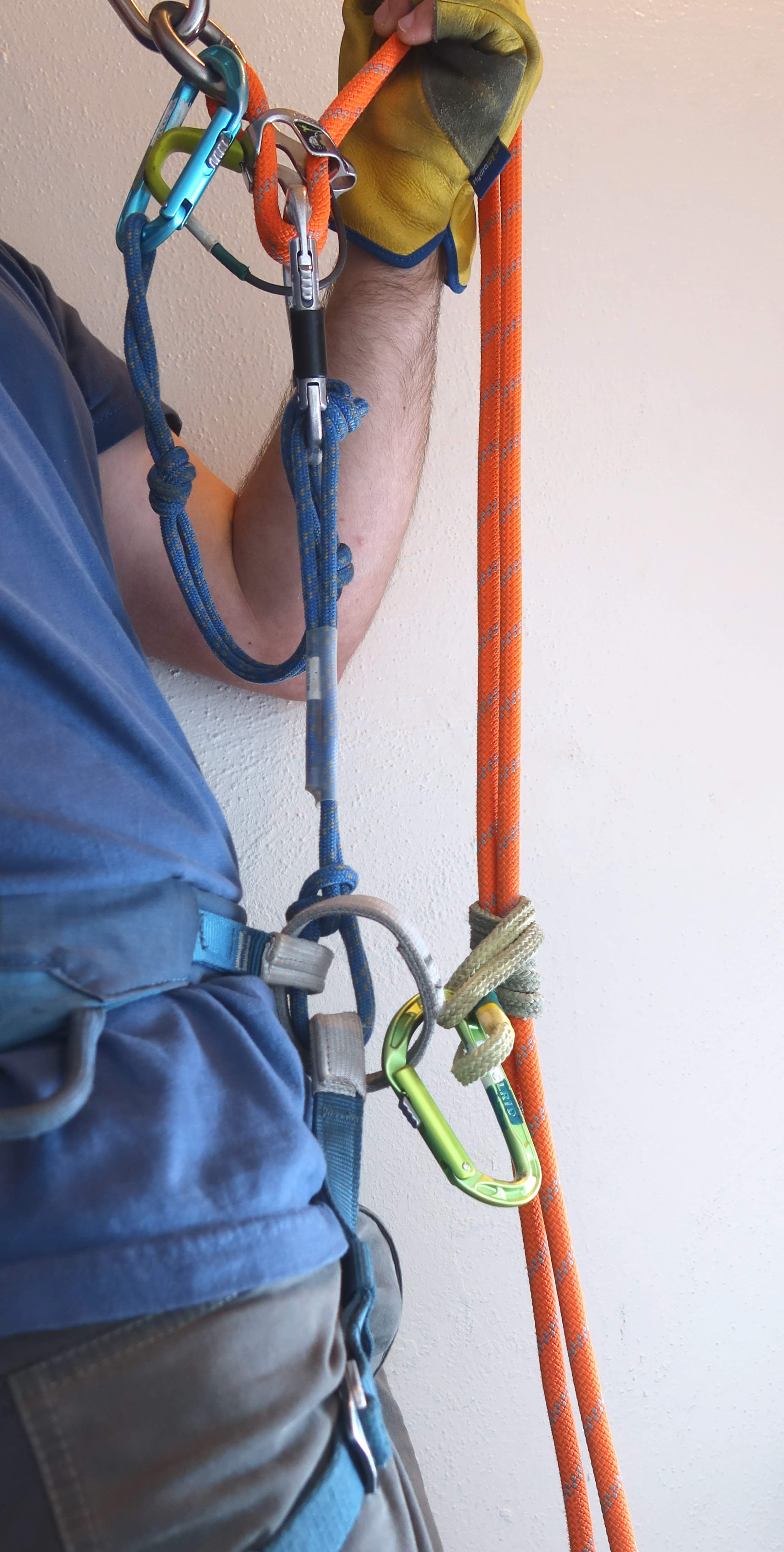
#7. Now actually test: Sit down and put your full body-weight on the rappel setup. Observe that the rappel setup holds you, and that the autoblock engages, so that you know you do indeed have a system that would stop if you were to let go.

#8. Finally, you can begin your rappel. Yell “<<your name>> is On Rappel!“, keep your brake-hand closed around the brake-strands, and unclip your PA from the anchor. A great place to clip the PA’s locker for storage is back to your belay-loop, a nice and convenient place to reach, so that it’s ready to use as soon as the next anchor is in reach.

A bit niche: Rappelling with Assisted-Braking Enabled

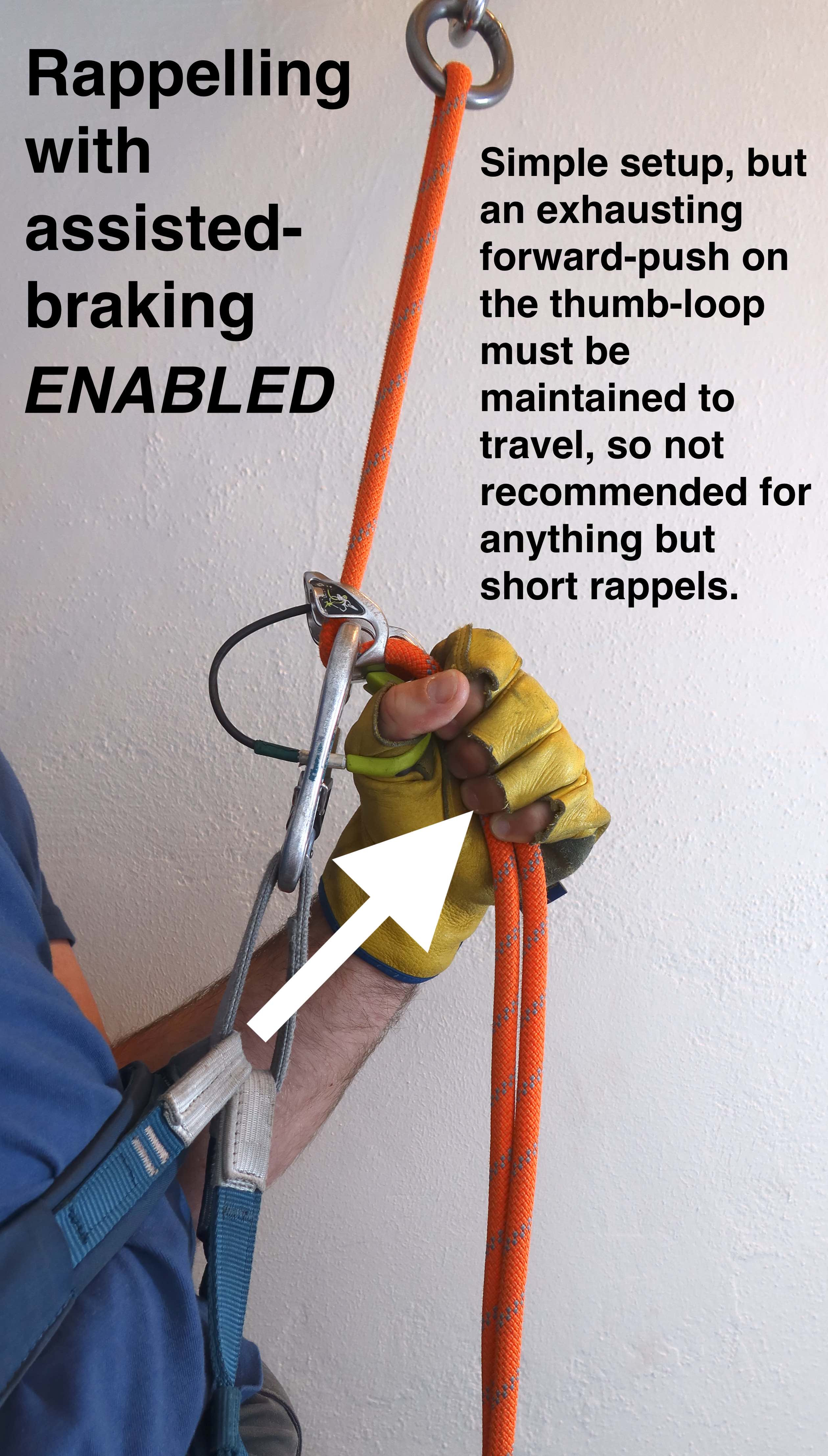
Above I talked a lot about rappelling with the assisted-braking function disabled, and surely some are wondering: what if you switched things and tried rappelling with the assisted-braking enabled? i.e., instead of the lime-green-thumb-loop being “up and in”, what if it was where you would regularly put it for a normal top-rope-belay or lead-belay? Well, then you would have to use muscle to constantly push forward on the lime-green-thumb-loop to overpower the assisted-braking in order to go anywhere. It does work, but it’s very tiring to maintain that forward push for the length of a rappel, so you’re probably not going to be happy about doing it on anything other than short single-pitch rappels.

No autoblock here: If you are going to rappel with the assisted-braking enabled, then you can skip the use of an autoblock. Remember Rob’s-Rule-of-Rappelling #2? “Always use a system that will stop if the rappeller lets go.” This rappel setup is still compliant with that rule, because it’s the assisted-braking should cause the system to stop if you let go. (But be careful, and don’t put too much trust in the “should” there. It can vary with rope-diameter, which is why: ahem, rule #3: you must always test before you trust!)

No extension: Since there’s no autoblock required, then you can and should also skip the rappel-extension. Instead just set up the rappel directly on your belay loop. This turns out to be necessary for ergonomics, for that constant-forward-push you’ll need to maintain on the thumb-loop in order to move at all. It’s much easier to apply that constant-forward-push to something located close to your waist, than it would be to apply a constant-forward-push to something at the height of your forehead.

The advantage of this setup is that it is very quick to set up and put away, there are a lot fewer extra items involved than the standard rappel setup. I do use this myself, but only occaisionally, in the niche scenario of only one rappel to do, and not that long of a rappel to do, so that it won’t be that tiring on my arm.

About gloves: Personally, I always prefer to rappel with gloves. I generally lightly-encourage others to wear rappel gloves too, but I don’t go so far as saying that they are “mandatory.” If someone I’m responsible for on a trip chooses not to wear rappel gloves, I generally let them make that choice for themselves. However, if you do use this setup, I would give a little extra-encouragement in favor of actually wearing the rappel gloves, I do find that there’s a little more rope-friction against the hands in this setup than there is with extended rappel.

Belaying a Follower (From Above, Plaquette-Mode)

Belaying a follower, belaying from above, belaying in guide-mode, belaying in plaquette-mode are all different ways of saying the exact same thing. There’s plenty of excellent videos out there about the correct setup for doing this with an ATC or Reverso:

But before I show the MegaJul’s version of this setup, we have to talk about a potential problem with ALL of this style of belay device…

First, be aware of a danger that affects ALL guide-mode / plaquette-mode style devices

If skinny ropes are used, and only a single strand of rope passes through the plaquette-mode belay device, it is possible for the strands to squeeze-by eachother within the device’s aperature, as shown here:

☠️ This is a pretty scary problem: with enough of a pull-force downward on the climber’s strand (the direction it would indeed be pulled in a fall) along with a fairly-minor upward-pull on the brake-strand (easy to do, and it doesn’t even have to be an upward pull, just less of a pull than the pull-force on the fallen-climber side can cause this), the result is that the brake-side and climber’s-side of the ropes have passed eachother within the device’s aperature. This means that the built-in braking that any plaquette-mode setup is supposed to provide is no longer there, and without a firm grip on the brake-side, the rope could easily run freely, dropping the climber. ☠️ The above GIF shows this happening with a Black DIamond ATC, and the dark-blue rope is a 7.9mm climbing rope. That rope is rated as a half-rope/twin-rope, and so in theory it shouldn’t be used single-strand like this. However, the key unknown is: we don’t know what rope-diameter this can vs cannot happen with. Some ropes are thick enough that this problem can’t happen, and some ropes are skinny enough that it can happen. I do not know where the line is. And even if we did, it’s probably not a simple universal number, different rope-constructions may do this at different diameters.

So how do we prevent this? One option is to clip that locking carabiner fully around the device, like this:

With the carabiner clipped around the device, then the carabiner is unable to do that 180° flip that happened in the demonstration of the problem, making it much less likely for the two strand to be able to fully pass eachother. So that’s one way of preventing this. Edelrid does recommend this solution in the literature they provide. Black Diamond could be recommending this solution in the literature that comes with an ATC, and Petzl could be recommending this solution in the literature that comes with a Reverso. However, neither of them are recommending this. Why? Well, it is a really annoying solution: it’s kinda hard to clip the carabiner fully-around the device like that. And with the carabiner clipped that way, it’s no longer possible to use the “ratchet trick” to let out just a little bit of rope while under tension. Most of all: I think this “solution” might actually be unnecessary. There is some rope-diameter that’s wide enough that this isn’t a problem, I just don’t know exactly what diameter that is. But I’ve been belaying with single-rated ropes that are somewhere in the middle of the 9.0mm to 10.0mm range for years, and I haven’t had this problem. By far the most common diameter of rope I’ve used is 9.5mm. I’m inclined to think that this isn’t an issue with 9.5mm diameter ropes because (1) it hasn’t been an issue for me personally with ropes of that diameter, and more importantly: (2) if it was an issue with 9.5mm ropes, which is a very common size, other manufacturers would certainly be making changes or at least putting more mitigations in their literature! So, since Black Diamond is okay with me belaying with a single-rope without clipping the carabiner around the device, and Petzl is okay with me belaying without clipping the carabiner around the device, and Edelrid’s MegaJul works on the exact same physics as those two devices when setup for plaquette mode: I’ve decided to go back to simply clipping the locking carabiner behind the MegaJul, rather than around it.

The MegaJul-Specific Setup for Belaying From Above

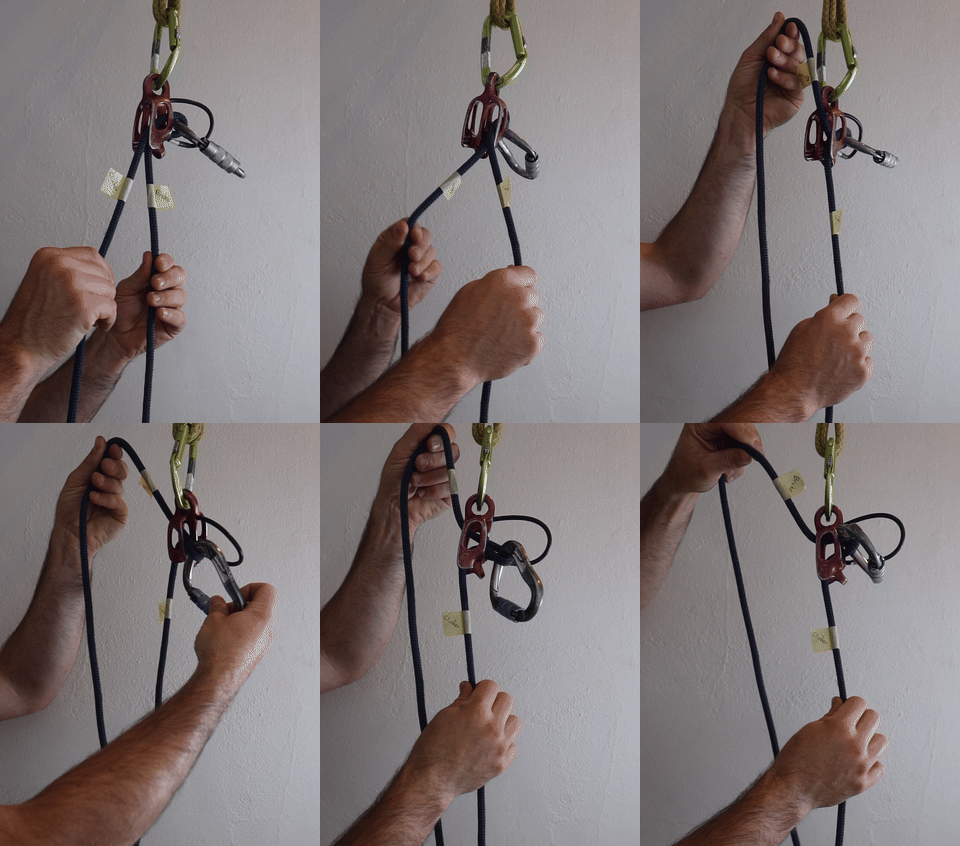
#1. Hang the device from the anchor like this:

#2. Push the rope in up from the bottom. That “up from the bottom” part is the main weirdness about the MegaJul here if you’re used to using an ATC or Reverso in plaquette-mode.

#3. Now to clip that last locking carabiner…

This is when we need to think about that danger that affects any plaquette-style belay device described above, that danger of carabiner-flipping and rope-strands trading places. Do we clip the locking carabiner in the back so that it hangs freely? Or do we clip the locking carabiner fully around the MegaJul? I talked through my thought process on this above, with the ATC example, and personally, as long as my rope is about 9.5mm in diameter or thicker, I simply clip the locking carabiner in the back so that it hangs freely, like this:

And here’s the whole process:

#3-Alternate:

Alternatively, if you did want to clip the carabiner fully around the belay device, you can do so. (Note: if your rope is skinny enough to need this solution, then you would also need to do this solution if you were using a BD ATC or Petzl Reverso instead.) Folding a loop of rope over can make the clipping much easier, like this:

Advanced Skills

Advanced Skill: Lowering a Follower

Advanced Skill: Raising a Follower

Advanced Skill: Switching mid-rappel to rope-acension

Some notes on the West Ridge of Forbidden

Some other excellent trip reports:

I got all the beta I needed from these two trip reports. Thank you Isley and Jianing for your write-ups!

Contents

  1. Some other excellent trip reports:
  2. Strategy
  3. On route:
  4. Rappelling the Cat Scratch Gullies
  5. Gear

Strategy

The route is inherently time-consuming, even with strategies employed to “go fast”. To climb the West Ridge, the two most appealing strategies are (1) do it in-a-day, with no backcountry camping, or (2) get backcountry camping permits for the ‘Boston Basin Cross Country Zone’ (organized under “High Use Cross Country Zones”) and spend at least one night at the Boston Basin High Camp (at 6200′, around 48.5012, -121.0638). Whether you camp or not, going for the summit is going to be quite a long day. In-a-day, you can expect a 17-hour car-to-car day if things go well, and it’s certainly possible for the day to be considerably longer if anything goes less than perfectly. Even with camping: a 12-hour day camp-to-camp is fairly common. The approach from car to camp can be only 3 hours if you bang it out. Getting out from camp-to-car can be only 2 hours. (But add an hour to break camp, so even with high-camp strategy, camp-to-summit-to-cars becomes a 15 hour day in best case scenario; still a very long day.) In any case, parties should be prepared for the possibility of an emergency-bivy somewhere unexpected, as the chances doing one are relatively higher on this route than most. I recommend each person carry a light mylar emergency bivy bag, a bit of extra food, maybe some caffeine, and extra headlamp batteries (or perhaps a whole second headlamp) in their summit-packs, just in case. The biggest hazard on this route is other-parties, both in terms of potential rockfall concerns in the Cat Scratch Gullies, and also just the time-cost of traffic delays. One of the best ways to make this route relatively-safer is to climb on a weekday, instead of a weekend. It’s also significantly easier to get camping permits for a mid-week trip. Even though camping doesn’t shave that much time off of summit-day compared to doing the trip entirely in-a-day, camping with an alpine-start gives you much better odds of actually being first on-route than starting from the cars with an alpine-start.

Continue reading

Ptarmigan Traverse

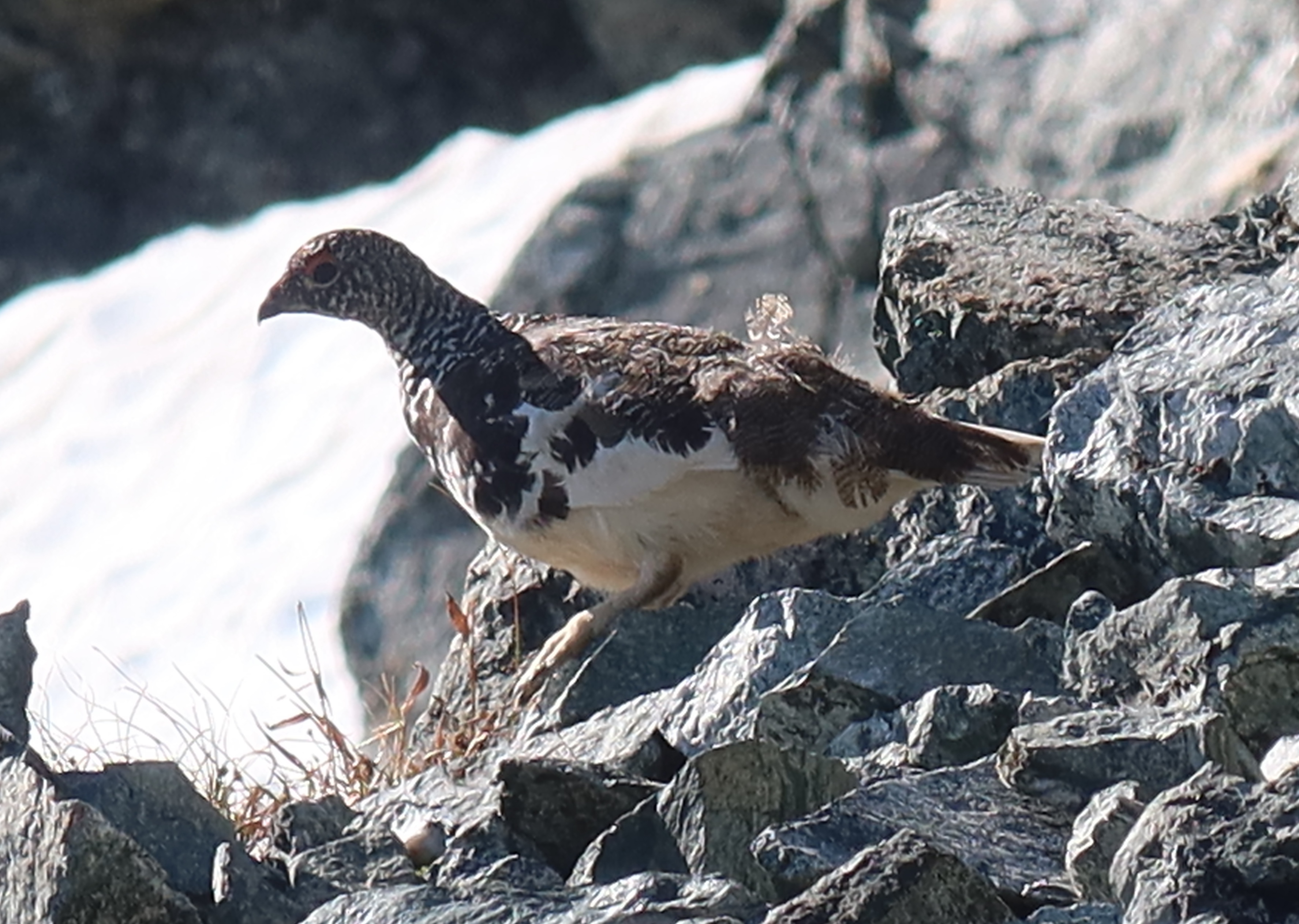
We got to see a ptarmigan on the Ptarmigan Traverse! That’s gotta be some kind of good omen. We saw this guy along the scramble up the the summit of Le Conte.

The Ptarmigan Traverse is an absolutely classic and must-do experience at least once for anyone who’s into mountaineering in Washington state. Some high-level details:

  • Technical skillset: In its simplest version, as just a through-traverse (e.g., not yet considering side trips to summit nearby peaks), it can be done with only a “Mountaineers Basic” skill-set: the technical challenges are basic glacier travel and scrambling, and the trip is otherwise essentially backpacking-for-mountaineers.
  • Time commitment: While this route has been trail-run in insanely fast times, if this is your first time on it, I’d recommend allocating something more in the ballpark of a 6 or 7-day schedule.
  • A car-shuttle is required, which (from Seattle) means nearly 6 hours of driving prior to the boots-on trailhead at the beginning, and nearly 6 hours of driving after the boots-off trailhead at the end. Two cars are required, and each must display a Northwest Forest Pass (or an America the Beautiful Pass).
  • Permits: Somewhat astoundingly, this route doesn’t require any camping permits (yet… I imagine some day in the future it will.) What an incredible gift from nature this place is in the first place, and what a privilege it is that we are currently able to recreate there without the hassle of a permit system being needed yet. Popularity is only increasing, and it is crucially important that we each do our part to care for and preserve the land here by doing everything we can to minimize the way our presence impacts it: avoid killing the struggling alpine plants by–as much as possible–avoiding going off-trail and stepping on them, or setting up tents on top of plants, or peeing on plants (which will make a mountain goat eventually dig at that spot, shredding a square foot or so.) Store food appropriately (large Ursacks are ideal) to avoid habituating wildlife, which could lead to area-closures, and you don’t want to be “that guy” that ruins it for everyone else. And practice good backcountry bathroom etiquette (more on that below, but in short: at least pack out your used toilet paper!!) Be thoughtful and continuous towards the land, keep the area just as beautiful for the people who will come after you; and don’t do anything that would hasten or become a reason why a permit system would need to be established.
  • The prime time of year to aim for is likely early to mid-July (for the best chances of stable sunny weather, but also crevasses not having opened much yet.) Consider avoiding a schedule that incorporates the July 4th holiday, though, as it is likely that a lot of other people will have the same idea, and many of the camps along the route are limited in space.
  • An alternative to the Ptarmigan Traverse: For a similar trip in many ways, another option is the Bacon-Hagan-Blum Traverse, detailed in this video: https://www.youtube.com/watch?v=06M05mRV5pc&ab_channel=TheMountaineers It’s not quite as classic as Ptarmigan, but it is also an outstanding trip of its own, and would be significantly less crowded, even if scheduled over a national holiday.
Continue reading

La Croupe du Poney

On Saturday, June 14th, 2025, Kelly Ryan and I climbed a rock buttress in the Washington Pass area that had no previously-documented ascents. It has 1000′ of mostly moderate and enjoyable granite climbing, with trees available for almost every belay station. The route is solidly Grade III in size. We swung leads for eight long pitches, where I led the odds and Kelly led the evens. We estimate that maybe one pitch was 5.9, and a number of others were 5.7 / 5.8, but we look forward to second-opinions, as there were factors that could have led us to over-estimating difficulties at the time. The buttress overall has a fairly consistent slope-angle of just over 60°. There is a walk-off from the top, which returns to the route’s base. The route is minorly committing, in that completing it and walking off would be the preferred way off; though if a mid-route retreat were really necessary, many trees are available that a party could leave slings on, and a series of many <30-meter rappels would return you to the beginning.

Continue reading

Getting on Climbs with the Seattle Mountaineers

The Mountaineers is a big part of my life, it’s big a community which I very much love and appreciate! I’ve long been plugged into the Seattle branch and the climbing programs there.

If you are new to The Mountaineers, here are some links to help you orient:

  • The organization’s homepage: https://www.mountaineers.org/
  • The overall list of visible upcoming scrambling & climbing courses: https://www.mountaineers.org/courses/courses-clinics-seminars#c9=&b_start=0&c4=Climbing&c4=Scrambling
    (Note: Many courses repeat on a yearly cycle, and have an application period and sign-up during the late-fall or early-winter months, e.g. Oct, Nov, Dec., so to get in that’s when you need to be looking & applying. The actual course workshops/lectures/field-trips/etc. typically happen during the late-winter & spring months, mostly wrapping up by June. Then, during the summer-ish months, June through early October, anyone who is an approved Scramble Leader or Climb Leader can post Mountaineers Scrambles & Climbs as official-club-activities in the mountains, and students who were in courses need to sign up for and complete a certain number of those in order to fully graduate from their course.)
  • If you’d like to sign up for a course but aren’t sure which one, this unofficial diagram may help you navigate the rather-complicated structure of available courses.
  • If you have climbing experience outside of the Mountaineers and believe you qualify for ‘Equivalency’ for some course, read this page about Equivalency.
  1. The Biggest Problem…
  2. When Signing Up for Climbs…
  3. What makes a good Leader-permission-request?
  4. Getting more climbs posted
  5. Pain-Points as a Climb Leader, and tech “solutions” we’ll never get
  6. Some Bonus Info on Other Topics

The Biggest Problem…

Unfortunately, the most significant and most long-running problem faced there is that it is so hard to get on climbs, and has been for a long time. At least the official-club-climbs posted on the website. The problem is a huge asymmetry between the small number of official Climb Leaders who are posting trips, and the enormous number of students & graduates & other people trying to get on those trips. And I really do wish there were plenty of trips for everyone!! I love seeing people get outside and be active!! But a limited supply arises from issues with both the process of becoming an approved Climb Leader, (At what point is the level of friction in that process actually too much friction? Is the number of newly-approved Leaders unintentionally throttled more than necessary?) And also issues with the retention of active Climb Leaders: it’s entirely volunteer, and it’s kind of a rough job, it is so much easier to be a participant than it is to wear the responsibility of leadership (if the choice were there, pretty much everyone would rather sign up for a trip than lead one themselves), and enough people make it harder on leaders–whether they realize they are doing so or not–that leaders feel a lot of discouragement from leading trips. Fortunately, many leaders so strongly want to give that they overcome frequent-minor-discouragements for a very long time and still post a lot of trips, but retention isn’t going to last forever that way.

And I say to the the leaders who are active and posting trips: THANK YOU!!! No matter what trip you post, whatever personal-preference you have about how you post it or what you require for it, and even if you are only posting just one trip a year, still THANK YOU!!! You are giving a gift, and it is appreciated. Every single trip posted is one more trip posted, every single trip posted is an incremental addition. Every little bit helps, and the best path forward here is to get more trips posted!! Let’s create more leaders, and also make it more enjoyable for leaders to lead!!!

Okay, so what should you, as a student, be doing to get on official Mountaineers club climbs?

Continue reading

Sloan Peak – Corkscrew Route from Bedal Trailhead

If you are into mountaineering, Sloan Peak is a must-do classic summit. Its distinctive shark-fin shape and rather central location in the Cascade range make it a familiar appearance on the horizon from many other summits. That also means that conversely, when you do summit Sloan, you will be surrounded by a plethora of sightlines to many other familiar mountains in the North Cascades and Alpine Lakes regions, indulging both nostalgia for climbs-past and fueling stoke for climbs-future. And even aside from the views, the route itself is a fun romp on varied terrain, a sampling-platter of many alpine elements, but no part is so spicy that it’s overly stressful, and no part so big that it feels like volcano-slog. Overall, I find it to be delightful day out compared to many other larger or more-stressful alpine climbs. Heck, it could even be a good “first glacier climb” for someone to get experience with their systems on the relatively-short glacier crossing, as long as they’ve got the fitness and scramble-experience to be otherwise ready for the day.

Overview

  • The key difficulties are basic glacier travel, and a fair amount of 3rd class scrambling.
  • When to go: July & August are the safest bets for finding the route in good condition. Above 7200′, the route makes use of lovely trails on high heather ledges, but with a ~500′ drop over a precipice at the edge of the ledge. Those ledges must be snow-free to be safely passable, so snowcover there will likely turn-around attempts on the summit before late-June. On the other side of summer, you want to go before the glacier crossing gets too broken up. I’m not entirely sure at what point in summer the glacier typically becomes impassable, but my guess is sometime in September. I imagine summits could still be made during September, but the difficulty and technicality of the glacier crossing will go up.
  • Summit at 7835′.
  • Note that there are two different trailheads / approaches from which Sloan Peak can be accessed. (1) from the north, the “Sloan Peak Trailhead” (a.k.a. “Cougar Creek approach”) at 1919′ elevation, is a pull-off along road FS 49, where the road is better, but the North Fork Sauk River must be crossed, which is a pain at best, or a complete blocker at times of high-water. Or, (2) from the west, the “Bedal Creek Trailhead” at 2790′, which requires driving a pretty awful side-road (FS 4096) to access, but once the drive is done it’s all better from there, starting higher and with no creek to cross. I’ll focus on the approach from the Bedal Creek Trailhead.
  • Strava & Peakbagger links for the GPX track.
  • Stats: 5300′ of gain, 9.5 miles round trip.
  • Par-for-the-course on time is about 13 hours car-to-car. Or notably less if your party is particularly experienced & efficient.
  • In my opinion, the best way to do the route is in-a-day, with a car-bivy the night before, so you can start hiking at perhaps 4:00am. (Though if you really wanted to camp out there, you could do so, there’s space for 4 to 6 tents total (consider other parties) at 48.05673, -121.34298, at 5380′, near a pond that’s a bit stagnant.)
  • The FS 4096 road is quite bad, you definitely need a 4WD or AWD vehicle to get up it, and a decent bit of ground-clearance would be a good idea too.
Continue reading

Some notes on the North Ridge of Stuart

On July 26-28th, I had the opportunity to climb the Complete North Ridge of Stuart, as a 3-day trip. I’m so stoked and grateful that this opportunity came up, and that we were successful, I finally got to climb this route!! I have long dreamed of climbing this ultra-classic, since my first trad lead more than 12 years ago. I had held off on going for it for a long time, primarily out of concern about the climbing-difficulty of the crux pitches. I wanted to be extra-sure of my ability to on-sight 5.9 trad before making an attempt. I felt ready a few years ago, and had made an attempt, but opted to turn around before roping-up because the weather ended up being significantly cloudier & windier than what the forecast had predicted. This time though, everything went right!

There’s plenty of other information out there on the North Ridge, some I’m not necessarily going to write a complete guide to the route here. Even if I wanted to, a complete guide that shows where to go on all the pitches wouldn’t be possible or practical, there’s just so much ground to cover, it’s more important that you’re able to route-find on your own. This post is just going to be some notes from my one successful experience on the North Ridge of Stuart, partial beta that may or may not be a useful ingredient in the formulation of your own plan 🙂

Continue reading

Argonaut Peak via the south scramble route

There are quite a few possible routes to the summit of Argonaut Peak. Far from a complete list, here’s a few:

  • “South Route often refers to the technically-easiest route, a scramble up from the south, up from the Ingalls Creek valley, from a trailhead in the Teanaway region, where the crux is one 4th-class move which some will want a rope for. That 4th class move is stepping-right at a chockstone, just right of the “South Face,” and is typically descended with one 50-foot rappel. This “South Route” scramble is the route I’ll cover in more detail in the rest of this post.
  • “South Face often refers to an visually-striking wall at the summit with many possible lines for ~3-pitch rock climbing, where you could probably make it anywhere from 5.3 to 5.10 depending on which line you choose. This clean face of rock is fairly easy to see in any zoomed photograph of Argonaut taken from the south. The “South Face” and the “South Route” have the same approach–whichever one you are doing, you will scramble up to the base of the “South Face” first, then either go straight up it if rock-climbing, or scramble rightward at the base of the face to find the “South Route” gully & chockstone. And either way, the “South Route” down-scramble and rappel is your descent from the summit, so it would be very easy to retrieve any boots/packs/whatever stashed at the base of the “South Face” climbing route.
  • “NW Arete” is a rock climbing route that really catches my curiosity, reportedly 5.6 and about 6 pitches. Its location on the north side of the peak is different enough to warrant a completely different approach and trailhead, parking at the Colchuck Lake / Stuart Lake trailhead, passing through the Stuart Lake permit zone of the Enchantments, exiting the border of the permit zone a little before arriving at some high bivy site options. Once the route has been climbed and you’re on the summit, it’s a little unclear what the best descent route should be. Options include a scramble down “arduous steep scree” at a possibly-uncomfortable slope angle that does return to camp; or possibly doing a true carry-over, taking your overnight gear with you on the rock climb, so that you can traverse relatively easy terrain over to Colchuck to exit down that way, loop style. (More notes on the NW Arete later in this post.)
Continue reading